


What Is Reflection AI’s Beam Model and Why Does It Matter for Enterprise AI?
Article Summary
Reflection AI has launched Beam, an open-weight AI model built for coding, reasoning, and agentic workloads.
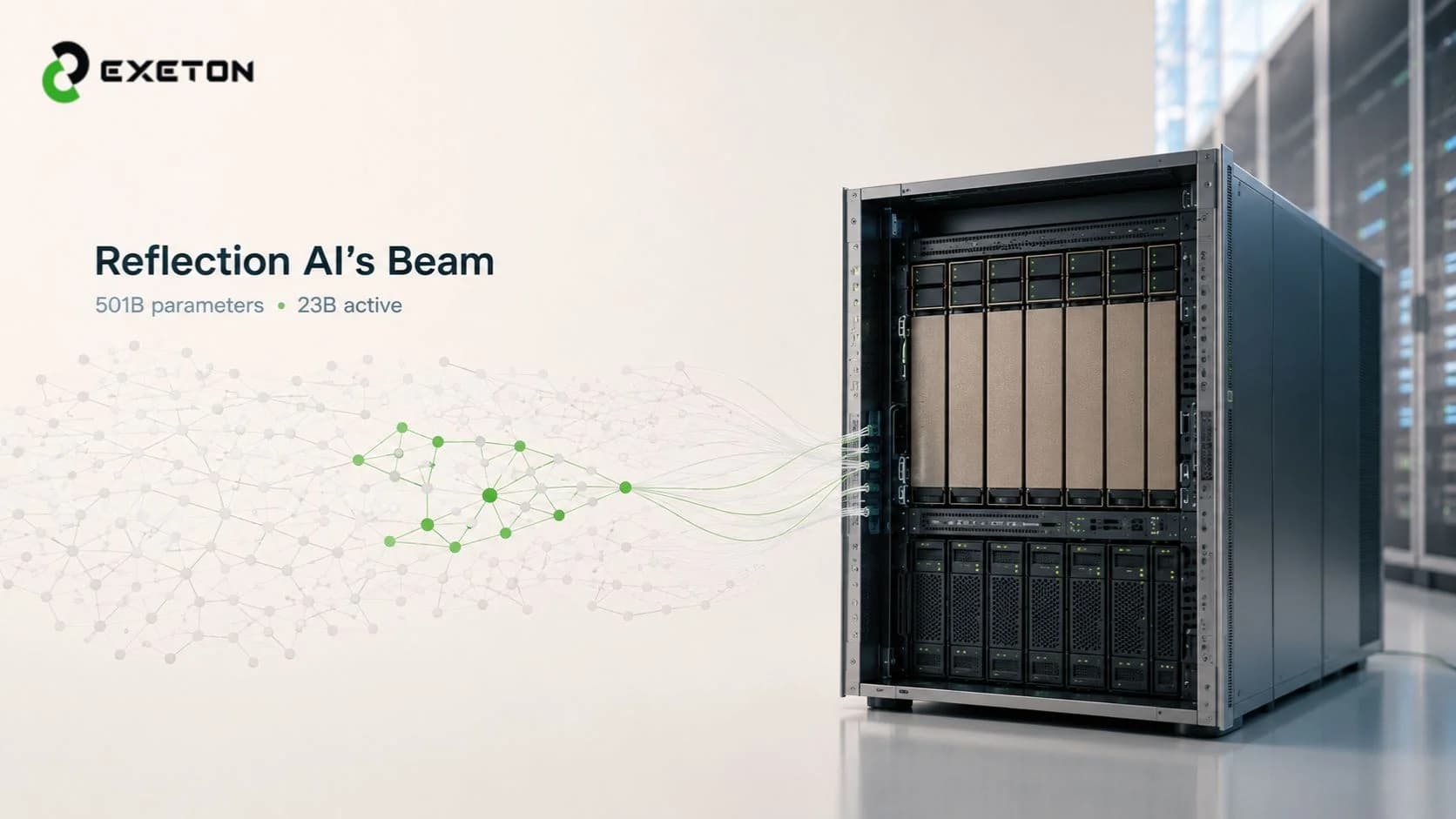
Beam has 501 billion total parameters but activates around 23 billion at a time, an approach designed to make large-scale AI more efficient to run.
The launch highlights a broader shift toward efficient, customizable AI models, making GPU infrastructure, servers, power, and cooling increasingly important for enterprises.
“Bigger” has long been the easy way to describe progress in AI. But what if the more important question is: How much computing power does an AI model actually need to get the job done?
That question sits at the heart of Reflection AI's new Beam model. The Nvidia-backed startup has introduced Beam as an open-weight model focused on coding and AI-agent tasks, entering an increasingly competitive market that includes models from DeepSeek, Qwen, Kimi, and Z.ai.
For businesses, however, the interesting part isn't simply the size of Beam. It's how the model uses computing resources, and what that could mean for the infrastructure required to run AI at scale.
What Is Reflection AI’s Beam Model?
Beam is Reflection AI's first open-weight AI model, designed particularly for coding, reasoning, and agentic software-development tasks.
An AI agent goes beyond answering a single question. It can potentially break a larger objective into steps, write or modify code, use tools, check results, and continue working toward a goal.
For developers and businesses, that makes models like Beam relevant to applications such as automated software development, coding assistants, and other AI-powered workflows.
The open-weight approach is also important. Instead of relying solely on a closed AI service, organizations can have greater flexibility over how a model is deployed and customized, depending on its licensing and technical requirements.
Why Does Beam Have 501 Billion Parameters but Use Only 23 Billion?
This is one of the most interesting technical details about Beam.
The model reportedly contains 501 billion total parameters, but activates approximately 23 billion parameters for an individual task.
The simplest way to understand this is to imagine a company with 501 billion specialists. You wouldn't ask every employee to work on every problem. You would bring in only the specialists relevant to the particular job.
This is broadly the idea behind a Mixture-of-Experts (MoE) architecture.
Term | What it means | Why it matters |
Parameters | Values that help determine how an AI model processes information | Contribute to the model's overall capability |
Active parameters | The portion used for a particular task | Can reduce the computing required per request |
Open-weight | Model weights are made available for use or customization | Gives developers greater deployment flexibility |
Inference | The process of running a trained model to produce an answer | Can become a major AI infrastructure cost |
The distinction between total and active parameters matters because running a large AI model isn't simply about how many parameters exist. How many are actually being used can have a significant impact on computing requirements.
Is Beam Better Than DeepSeek, Qwen or GLM?
It is too early to make a definitive statement.
Reflection AI has positioned Beam as competitive with leading Chinese open-weight models on coding and agentic workloads. However, comparisons between AI models can vary significantly depending on the benchmark, hardware, prompting method, software environment, and workload.
That means businesses shouldn't judge a model based on parameter count alone.
A more useful question is:
How well does the model perform on the specific tasks an organization needs it to handle, and what does it cost to run those workloads?
That cost-performance equation is becoming increasingly important as AI moves from experimentation into everyday business operations.
Why Does Nvidia’s Backing of Reflection AI Matter?
Nvidia's connection to Reflection AI is significant because modern AI development depends heavily on computing infrastructure.
Training and running advanced AI models requires powerful GPUs, high-speed networking, storage, and substantial power and cooling capacity.
For Nvidia, the growth of AI models and AI applications can translate into continued demand for the infrastructure used to develop and deploy them.
For Reflection AI, access to this broader AI ecosystem can help support the computational demands involved in developing and operating increasingly capable models.
The relationship illustrates something easy to overlook: AI software and AI hardware are becoming increasingly interconnected.
What Does Beam Mean for Enterprise AI Infrastructure?
A more efficient model doesn't mean businesses suddenly need less infrastructure.
If organizations deploy AI agents across thousands of users, applications, or automated workflows, the overall workload can still become substantial.
Enterprises may need to consider:
GPU performance and memory
Server configuration
Networking capacity
Storage performance
Power availability
Data-center cooling
Model deployment and monitoring
For organizations evaluating infrastructure for demanding AI workloads, choosing appropriate enterprise GPU servers becomes an important part of the equation.
Could More Efficient AI Models Change Data-Center Cooling?
Potentially, but efficiency doesn't eliminate the physical challenges of AI infrastructure.
High-performance GPUs generate substantial heat, particularly when running demanding workloads continuously. As organizations deploy more GPUs per server and more servers per rack, thermal management becomes increasingly important.
This is why cooling technology is becoming a major consideration alongside GPU performance.
For organizations operating dense AI GPU infrastructure, immersion cooling for AI GPU data centers is one approach worth understanding.
Learn more about immersion cooling for AI GPU data centers.
What Should Businesses Consider Before Running an Open-Weight AI Model?
Choosing an AI model is only one part of the deployment decision.
Businesses should also ask:
What GPU memory does the workload require?
Will the model run on-premises, in a private environment, or through the cloud?
How many users or AI agents will access it?
What power and cooling capacity is available?
What networking infrastructure is required?
How will the model be monitored and maintained?
What security and compliance requirements apply?
Can the infrastructure scale as usage increases?
Compliance and documentation can also become important when organizations deploy advanced computing equipment across different markets and applications.
See Exeton's AI and computing compliance forms.
What Could Beam’s Launch Mean for the AI Industry?
Beam is part of a broader change in how AI companies are competing.
The conversation is gradually moving beyond “Who has the biggest model?” toward questions such as:
How capable is the model? How much does it cost to run? Can businesses customize it? And can the required infrastructure scale economically?
Open-weight models are particularly relevant to this shift because they can give organizations more control over deployment than purely closed AI services.
At the same time, coding and AI-agent applications could create significant demand for inference infrastructure as businesses automate increasingly complex workflows.
Frequently Asked Questions
What is Reflection AI Beam?
Beam is an open-weight AI model from Reflection AI designed for coding, reasoning, and agentic workloads.
How many parameters does Beam have?
Beam has 501 billion total parameters, with approximately 23 billion active parameters used for a given task.
Why does Beam use only 23 billion active parameters?
Its architecture allows only a portion of the model to be activated for a particular task, potentially reducing the computing required compared with activating the entire model.
Is Beam competing with DeepSeek and Qwen?
Yes. Reflection AI has positioned Beam as a competitor to leading open-weight models, including models developed by Chinese AI companies.
What is a Mixture-of-Experts model?
A Mixture-of-Experts model divides a large neural network into specialized components and selectively activates relevant components for different tasks.
Why is Nvidia connected to Reflection AI?
Nvidia is a backer of Reflection AI. The relationship connects an AI model developer with one of the major providers of the GPUs and computing infrastructure used across the AI industry.
Conclusion: AI Efficiency Is Becoming an Infrastructure Story
Reflection AI's Beam launch is about more than another large AI model entering an increasingly crowded market.
Its 501 billion total parameters and 23 billion active parameters highlight a bigger industry trend: AI companies are looking for ways to deliver powerful capabilities without necessarily activating an enormous amount of computing for every task.
For enterprises, that makes the infrastructure conversation just as important as the model itself.
As AI agents, coding tools, and automated workflows become more capable, businesses will need to think about GPUs, servers, networking, power, cooling, security, and compliance alongside the software.
Reflection AI's Beam is another signal that the future of enterprise AI won't be determined only by the models themselves. It will also depend on how efficiently organizations can run them.