


Immersion Cooling for AI & GPU Data Centers: Single-Phase vs Two-Phase Explained
Article Summary
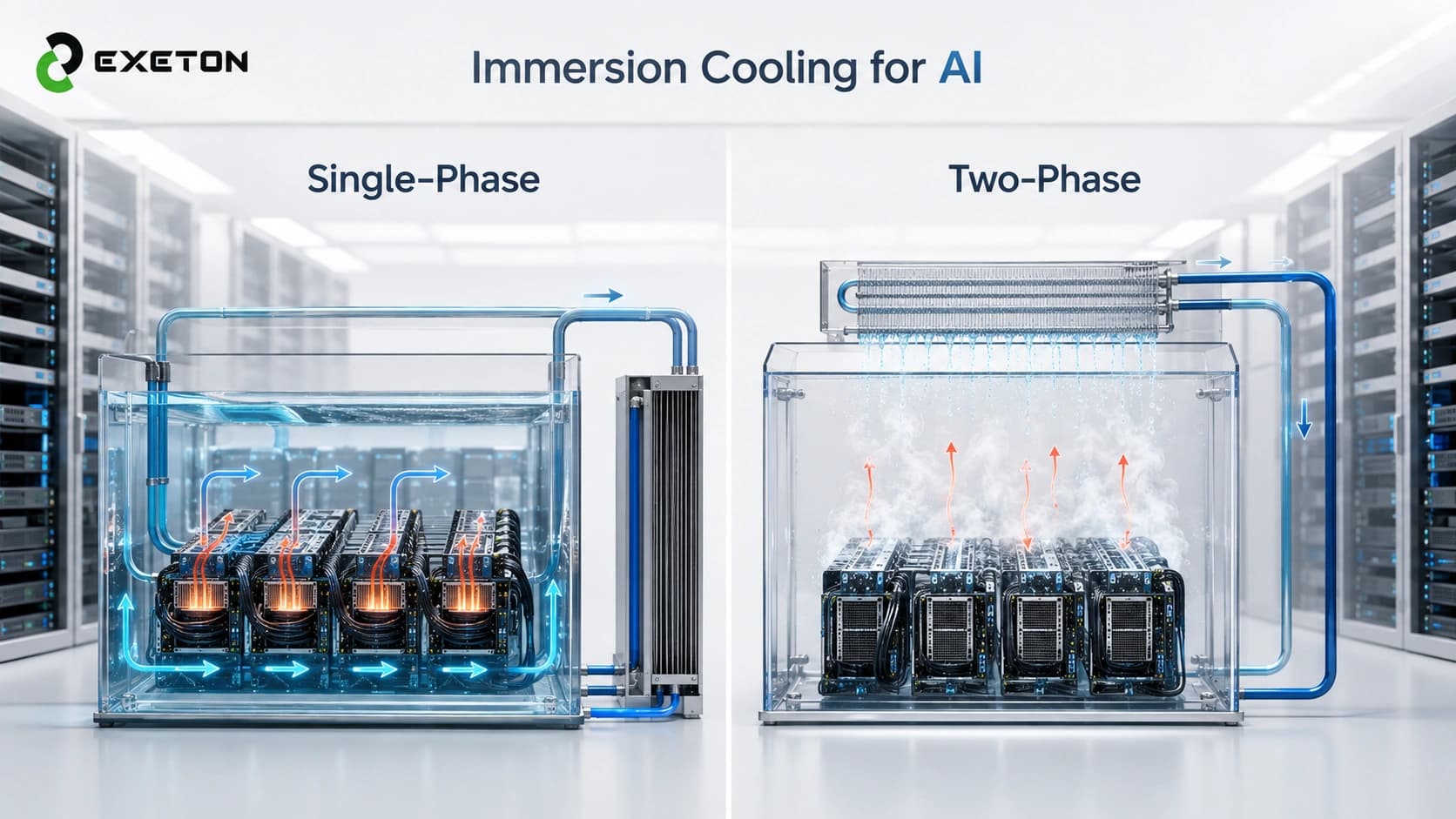
Single-phase immersion keeps the dielectric coolant in liquid form while heat is transferred to a secondary cooling loop.
Two-phase immersion uses a dielectric fluid that boils around heated components, then condenses back into liquid.
The right approach depends on GPU density, rack design, facility infrastructure, operating requirements, maintenance model, and deployment goals.
What happens when a rack of AI GPUs generates more heat than traditional air cooling can comfortably remove? As GPU power density increases, data center operators must reconsider how heat is transferred, rejected, and managed across the facility.
Immersion cooling is one approach to supporting high-density GPU infrastructure. It places servers or selected components in a non-conductive dielectric fluid, allowing heat to move from the hardware into a cooling system designed for the deployment. For organizations evaluating AI compute infrastructure, including those working with Exeton, understanding the differences between single-phase and two-phase immersion cooling is essential before selecting a solution.
Why Are AI GPUs Driving Demand for Immersion Cooling?
Modern GPUs concentrate substantial computing capability and electrical power into relatively compact systems. When multiple high-performance GPUs operate within a server or rack, the resulting heat load can create challenges for conventional air-cooling systems.
Traditional air cooling may become more difficult to implement as rack densities increase. Operators must consider airflow, heat removal, facility cooling capacity, and the thermal requirements of the hardware. Poorly managed temperatures can affect system reliability, operating conditions, and infrastructure planning.
Liquid cooling, including immersion cooling for AI data centers, offers an alternative way to transfer heat away from high-density computing equipment. Organizations deploying AI training servers should evaluate GPU power density and thermal requirements alongside compute performance.
However, cooling selection should be based on the complete infrastructure design rather than GPU specifications alone.
What Is Immersion Cooling?
Immersion cooling involves placing servers or selected heat-generating components into a non-conductive, or dielectric, fluid. Unlike ordinary water, a suitable dielectric coolant is designed to avoid electrically shorting the immersed equipment.
The cooling process transfers heat from GPUs, CPUs, and other components into the fluid. The heated fluid is then cooled through the system's heat-rejection mechanism, allowing the cycle to continue.
Immersion cooling is different from direct-to-chip cooling, where liquid is delivered through cold plates attached directly to heat-generating components. Both approaches can support liquid cooling for AI infrastructure, but they have different hardware integration and facility requirements.
Single-Phase vs Two-Phase Immersion Cooling: What's the Difference?
The key difference is how the coolant handles the heat transferred from the computing hardware.
Factor | Single-Phase Immersion | Two-Phase Immersion |
Fluid behavior | Remains liquid | Boils and condenses |
Heat transfer | Liquid carries heat away | Phase change transfers heat |
Cooling mechanism | Pumped or circulated fluid | Vaporization and condensation |
System concept | Circulation-based architecture | Phase-change architecture |
Infrastructure | Tank, circulation, heat exchanger | Tank, condenser, supporting systems |
Maintenance considerations | Fluid management and pumping | Fluid containment, vapor and condensation management |
Potential application | Dense GPU deployments evaluated for liquid cooling | Applications where phase-change cooling aligns with thermal requirements |
Specific implementations vary. Tank design, coolant selection, heat-exchange arrangements, and facility integration can differ between vendors and deployments.
How Does Single-Phase Immersion Cooling Work?
Single-phase immersion cooling uses a circulating dielectric fluid to transfer heat away from the immersed hardware.
The process generally follows these steps:
GPU servers are placed inside a tank containing dielectric fluid.
GPUs and other heat-generating components transfer heat into the fluid.
The warmed fluid circulates through a heat exchanger or cooling loop.
Heat is rejected through the facility's cooling system.
Cooled fluid returns to the tank.
This architecture may appeal to operators evaluating high-density GPU cooling because it uses a circulation-based approach. However, pumping requirements, heat-exchanger capacity, tank configuration, and service procedures must be assessed for the specific deployment.
How Does Two-Phase Immersion Cooling Work?
Two-phase immersion cooling relies on a phase change. Instead of keeping the coolant entirely in liquid form, the dielectric fluid boils when it absorbs sufficient heat from the immersed components.
The process works as follows:
Heat from the GPUs causes the dielectric fluid to reach its boiling point.
The fluid changes from liquid to vapor.
Vapor rises toward a condenser positioned within or above the tank.
Heat is rejected, and the vapor condenses back into liquid.
The liquid returns to the tank, repeating the cycle.
The phase change itself is central to the cooling mechanism. System design must account for the coolant's properties, vapor containment, condensation, and heat rejection. The suitability of this approach depends on the specific implementation and operating requirements.
Single-Phase or Two-Phase Immersion Cooling: Which One Fits an AI Data Center?
Neither technology should be treated as a universal solution. The decision should reflect the computing workload, server platform, facility design, and operational capabilities. For organizations planning AI cluster infrastructure, cooling selection should be evaluated alongside GPU density, networking, power delivery, and long-term operational requirements.
Consider single-phase when:
You want a comparatively straightforward liquid-cooling architecture.
Pumped fluid circulation fits your facility design.
Operational familiarity and serviceability are important.
You are planning dense GPU infrastructure and want to evaluate immersion without relying on phase-change cooling.
Consider two-phase when:
Phase-change heat transfer aligns with the deployment requirements.
High heat flux and thermal performance are major design considerations.
Your organization has the operational capability to manage the specific fluid and containment requirements.
Important: Actual suitability depends on the server platform, dielectric coolant, tank design, GPU thermal profile, facility infrastructure, and vendor implementation. A technology comparison alone cannot determine whether a particular system will meet the needs of a production AI deployment.
What About Cost, Maintenance, and Data Center Infrastructure?
Immersion cooling costs are deployment-specific. Initial investment can include tanks, dielectric fluid, heat exchangers, pumps or condensers, facility modifications, and supporting cooling infrastructure.
The commercial evaluation should extend beyond the equipment purchase.
Operators should consider:
Initial infrastructure investment and cooling-system integration.
Tank capacity, fluid requirements, and hardware compatibility.
Facility modifications, power distribution, and heat rejection.
Maintenance procedures, fluid management, and serviceability.
Long-term operating requirements and support arrangements.
Single-phase systems may introduce pumping and fluid-circulation requirements, while two-phase systems require attention to fluid containment, vapor management, and condensation. These differences can affect maintenance processes and operational planning. Organizations should also assess their broader data center infrastructure and support requirements before committing to an immersion cooling deployment.
There is no reliable universal cost-per-rack figure for every immersion deployment. A meaningful comparison requires a defined GPU configuration, coolant, tank architecture, facility environment, and operating model.
Is Immersion Cooling Better Than Direct-to-Chip Cooling?
Immersion cooling and direct-to-chip cooling use different approaches to transferring heat from computing hardware.
Immersion cooling: Servers or selected components are submerged in dielectric fluid.
Direct-to-chip cooling: Coolant flows through cold plates attached directly to heat-generating components.
Both approaches can be considered for high-density GPU infrastructure. The appropriate choice depends on rack density, server design, facility constraints, maintenance requirements, and deployment objectives.
Organizations evaluating AI infrastructure should compare the complete thermal architecture rather than selecting a cooling technology based on its operating principle alone.
Common Questions About Immersion Cooling
Does immersion cooling work for GPUs?
Yes. Immersion cooling can be designed for high-density GPU servers when the hardware, dielectric fluid, tank, and supporting infrastructure are properly matched.
Is single-phase immersion cooling better than two-phase?
Neither should be presented as universally better. They use different heat-transfer mechanisms and have different infrastructure and operational considerations.
Can existing data centers use immersion cooling?
Potentially. Retrofitting requires evaluating power distribution, server configuration, floor loading, cooling infrastructure, available space, fluid handling, and operational processes.
Does immersion cooling reduce energy consumption?
It can reduce cooling energy requirements in some deployments, but actual savings depend on the complete facility design, heat-rejection system, workload, climate, and operating conditions.
Conclusion: Evaluate Cooling as Part of the Entire AI Infrastructure
Immersion cooling is one option for managing the thermal demands of increasingly dense AI and GPU workloads. Single-phase and two-phase systems use different cooling mechanisms, and each brings its own infrastructure and operational considerations.
The right choice should be based on workload density, hardware compatibility, facility design, maintenance requirements, and long-term operating objectives. Cooling technology should be assessed as part of the entire system, including power delivery, networking, server integration, and heat rejection.
Exeton helps organizations evaluate AI and HPC infrastructure around their specific workload and deployment requirements. If your team is considering high-density GPU systems or liquid cooling, speaking with Exeton's solution engineers can help you assess the relevant infrastructure options and integration requirements.