



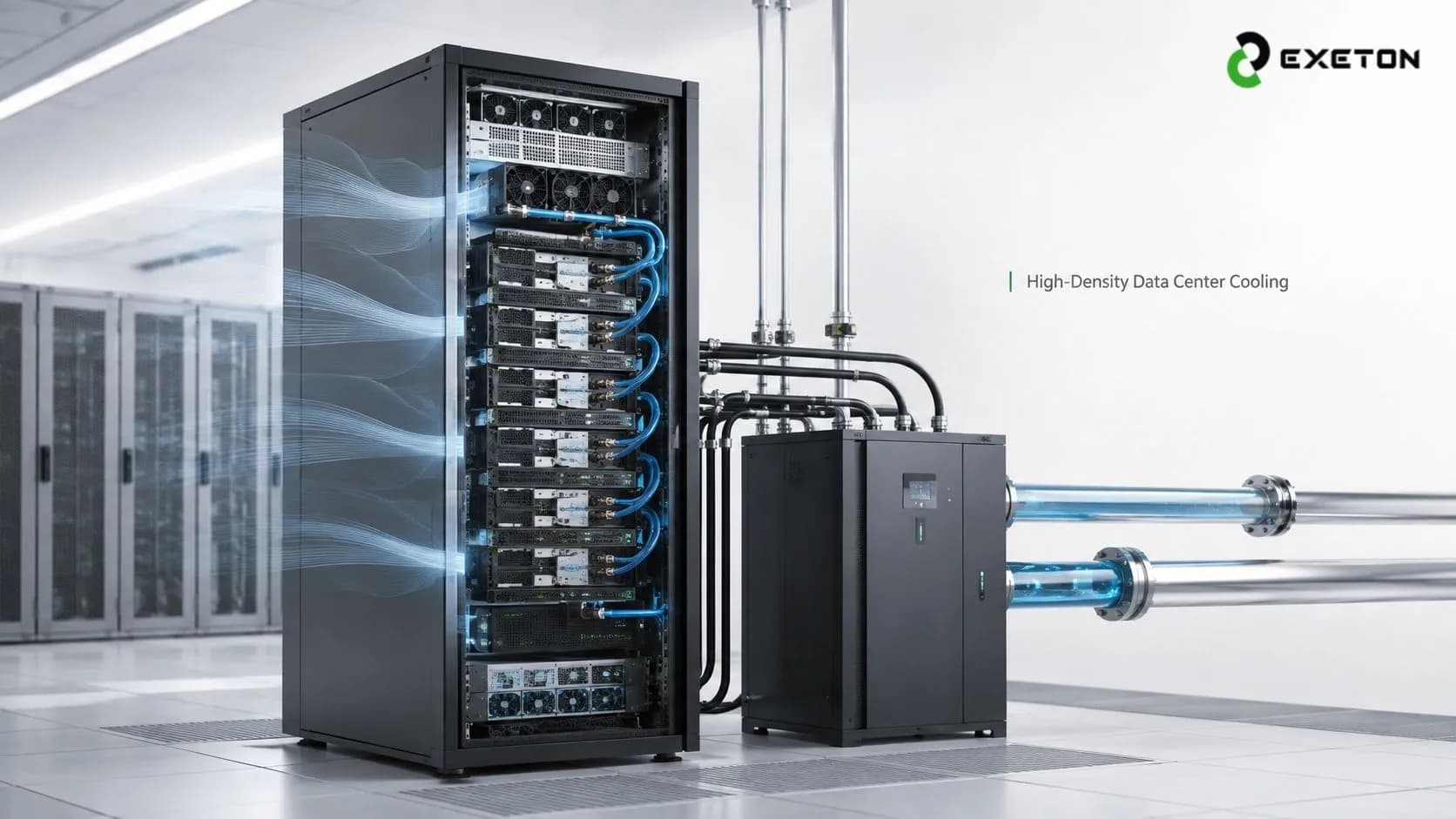
AI Data Center Cooling: The 2026 Guide to Liquid Cooling, GPU Rack Density & Thermal Infrastructure
What happens when the computing power of a single rack starts looking more like an entire room of servers?
As high-density AI servers and HPC platforms concentrate more compute and heat into each server and rack, conventional air-cooling systems face increasingly demanding airflow and heat-removal requirements. When airflow capacity and heat removal are not properly matched to the IT load, facilities can face higher fan and cooling-system energy consumption, thermal hotspots, and reduced operating headroom.
To maintain peak compute efficiency, enterprise facility operators are shifting toward next-generation liquid thermal management. Exeton provides AI hardware, GPU infrastructure, server solutions and data-center infrastructure services, helping organizations evaluate and deploy computing environments around their workload, density and facility requirements.
Here is an architectural blueprint of modern cooling systems, how they function, and how to select the right setup for your server room.
What Are the Main Cooling Methods for High-Density Data Centers?
Modern data-center cooling uses several approaches, from conventional air cooling to liquid-based systems such as direct-to-chip, immersion and rear-door heat exchangers.
1. Direct-to-Chip (DLC) Liquid Cooling
Direct-to-chip liquid cooling circulates coolant through cold plates attached to heat-generating components such as GPUs and CPUs. The coolant absorbs heat at the component and carries it to a coolant distribution system and ultimately to the facility's heat-rejection infrastructure.
Target Application: High-density AI training racks, GPU clusters, and dense blade servers.
Heat removal: Captures a substantial portion of processor heat directly at the source, reducing the amount of heat that must be handled through room-level airflow.
Key mechanism: Uses cold plates, manifolds and quick-disconnect couplings connected to a Coolant Distribution Unit (CDU) or other coolant-management infrastructure.
2. Immersion Cooling (Single-Phase & Two-Phase)
Immersion cooling places compatible IT equipment in a dielectric fluid that absorbs heat directly from the submerged components.
Target Application: Ultra-high-density hyperscale deployments and extreme compute workloads.
Heat removal: Transfers component heat directly into the dielectric fluid and can substantially reduce or eliminate conventional server-fan requirements, depending on the system design.
Key Mechanism:
Single-Phase: Dielectric oil circulates continuously through heat exchangers.
Two-phase: A dielectric fluid boils as it absorbs heat, producing vapor that rises and condenses on a cooled surface before returning to the fluid reservoir.
3. Rear-Door Heat Exchangers (RDHx)
Rear-door heat exchangers replace or integrate with a rack's rear door and use a liquid loop to remove heat from the server exhaust airflow.
Target Application: Facilities retrofitting existing air-cooled server rooms without full liquid pipe installations inside the server chassis.
Heat Removal Efficiency: Can significantly increase the amount of heat removed from a rack by transferring server exhaust heat into a liquid-cooled heat exchanger before that heat enters the room.
Key Mechanism: Server fans push warm air through chilled water or glycol loops integrated into the back of the rack.
4. Precision Air Cooling (CRAC/CRAH with Containment)
Computer Room Air Conditioning (CRAC) relies on chilled air pushed through raised floors into hot and cold aisle containment systems.
Target application: Conventional and lower-density IT environments where existing air-handling capacity can adequately support the planned rack load.
Heat Removal Efficiency: Standard efficiency; highly limited when handling multi-GPU AI servers.
Key Mechanism: High-volume airflow driven by central chillers and air handling units.
How do data center liquid cooling technologies compare?
The table below outlines the operational features, thermal limits, and infrastructure requirements across all four primary cooling setups:
Cooling approach | How it works | Best suited for | Main trade-off |
Air cooling | Conditioned air removes server heat | Conventional/lower-density IT | Increasing airflow requirements at higher density |
Direct-to-chip | Cold plates remove heat from GPUs/CPUs | High-density AI/HPC | Requires liquid distribution infrastructure |
Immersion | Dielectric fluid absorbs heat from immersed equipment | Specialized high-density deployments | Changes server servicing and facility operations |
RDHx | Liquid-cooled heat exchanger removes server exhaust heat | High-density racks and retrofits | Server airflow remains part of the cooling system |
Hybrid | Combines liquid and air cooling | Mixed or phased deployments | More complex system design |
Choosing the Right Cooling Architecture for AI Infrastructure
A practical decision framework starts with six questions:
What hardware are you deploying? GPU type, server chassis and manufacturer requirements matter.
How dense will the racks become? Design for the intended configuration, not just today's equipment.
Is the facility new or existing? Retrofit constraints can change the preferred architecture.
What cooling infrastructure already exists? Water loops, chillers and heat rejection capacity may influence the options.
How important are uptime and redundancy? Cooling failures can become IT availability events.
What happens in the next deployment phase? A solution that works for ten racks may not scale economically to fifty.
At Exeton, our certified systems engineers handle complete site assessments, precise heat-load modeling, and electrical supply planning to guarantee your liquid cooling deployment meets exact operational requirements without over-provisioning energy costs.
Frequently Asked Questions (FAQs)
What is the difference between Direct-to-Chip and Immersion cooling?
Direct-to-Chip (DLC) cooling attaches liquid cold plates directly to high-heat processors (CPUs/GPUs) while using air for auxiliary board components. Immersion cooling completely submerges the entire server chassis into a tank filled with non-conductive dielectric fluid, removing fans entirely.
Can an existing data center be converted to liquid cooling?
Yes, in many cases, but the approach depends on the facility. A retrofit may use direct-to-chip cooling, RDHx, hybrid cooling or a combination of approaches. Power, cooling capacity, rack construction, piping routes, maintenance access and expansion plans should all be assessed first.
Is liquid cooling safe for enterprise IT hardware?
Yes. Modern liquid cooling uses non-conductive dielectric fluids or sealed, leak-tested closed loops with dripless quick-disconnect couplings. Integrated pressure sensors and automatic shut-off valves eliminate hardware fluid exposure risks.
Why choose Exeton for your data center cooling setup?
Exeton is an ISO 9001 and ISO 27001 certified provider of enterprise IT infrastructure, high-density GPU server deployments, and turnkey data center solutions. Our expert engineering team provides full-service thermal calculations, equipment procurement, liquid loop installation, and SLA-backed maintenance to ensure uninterrupted uptime for your critical compute environments.
Need Expert Assistance with Your Data Center Cooling Design?
Whether you are scaling high-density AI server racks or retrofitting an existing enterprise facility, Exeton provides complete, ISO-certified thermal engineering solutions.
The best design starts with the actual servers, rack density, facility constraints, climate and growth plan, not with a predetermined cooling technology.
Planning high-density AI infrastructure? Talk to Exeton about your cooling and data-center requirements.