



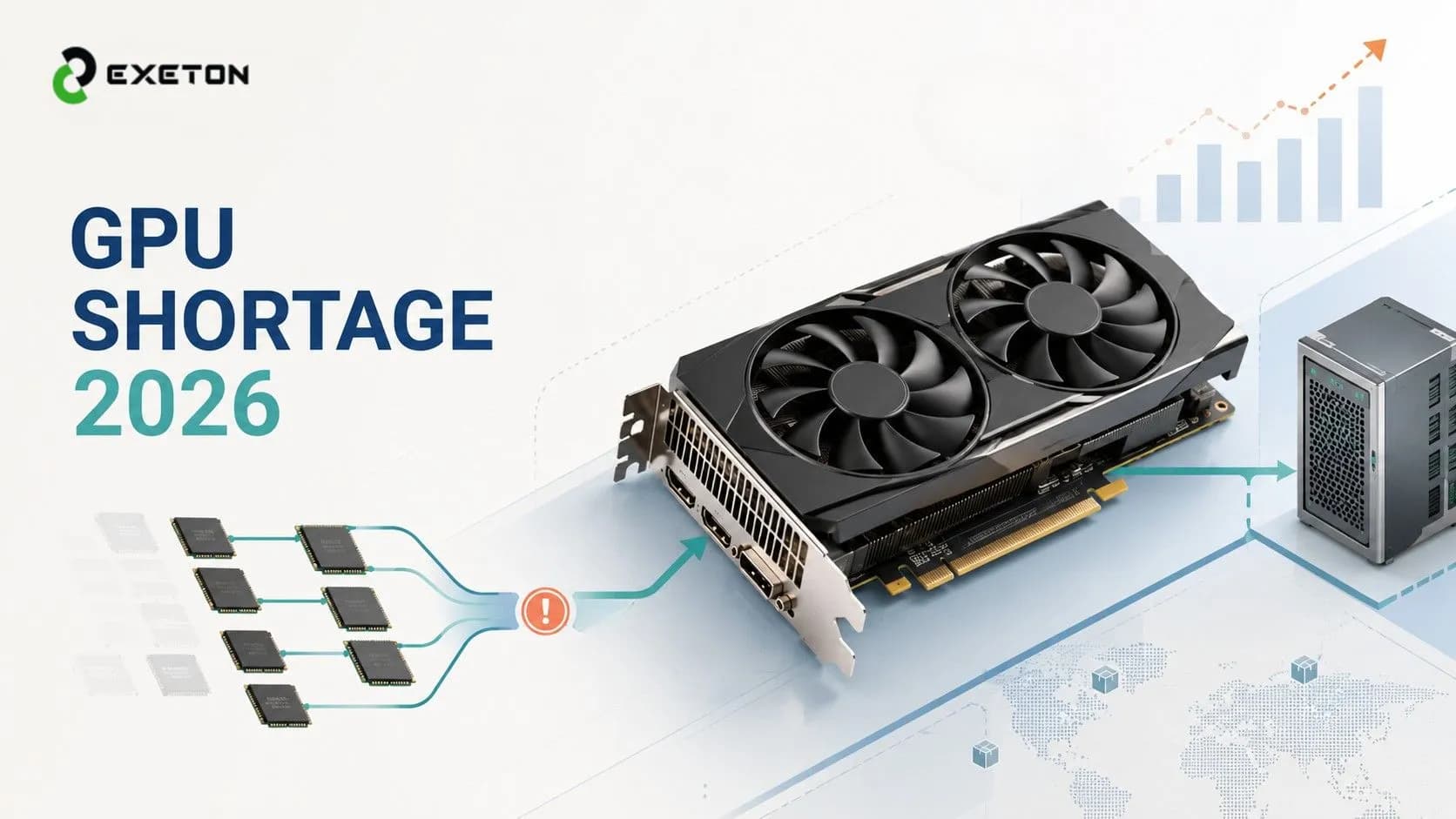
2026 GPU Shortage Explained: Why GPU Prices Are Rising, VRAM Is Scarce, and Should You Buy Now?
Standard GPUs are now up to 35% more expensive than they were six months ago, and baseline models are almost impossible to source.
If your organization has recently tried sourcing graphics hardware for workstation builds, local data analytics, or AI development, you have likely run into a frustrating wall. Base-tier, budget-friendly models from major manufacturers are missing, while only highly marked-up premium cards remain on distributor shelves.
This isn't a temporary retail glitch. Here at Exeton, we track hardware supply chain shifts closely to help teams make smarter procurement choices. What we are seeing in late 2026 is a structural "VRAM squeeze" caused by upstream memory manufacturing constraints.
Below is a clear, accessible breakdown of why GPU prices are surging, why entry-level models have vanished, and why delaying hardware purchases through 2026 could cost your finance team significantly more.
What Is Causing the 2026 GPU Shortage and Price Hikes?
The primary driver behind today's graphics card shortage is an upstream memory reallocation crisis. Modern GPUs rely on high-speed Video RAM (VRAM). However, major memory suppliers like Samsung, SK Hynix, and Micron have shifted a massive portion of their raw silicon wafer capacity away from standard graphics memory (GDDR6 and GDDR7) and toward High Bandwidth Memory (HBM3e and HBM4) required by massive AI data centers.
Because producing stacked HBM requires significantly more silicon wafer area than standard graphics memory, the global pool of GDDR memory chips has shrunk drastically.
Surging Component Costs: Higher GDDR memory prices directly increase the baseline cost to manufacture every graphics card.
High-Capacity Penalties: GPUs with 16GB, 24GB, or higher VRAM allocations suffer the largest price hikes because they require more of these scarce memory chips.
Key Term Defined:
VRAM (Video RAM):
Dedicated, high-speed memory soldered directly onto a graphics card. It acts as the card's short-term memory, holding data required for rendering visuals, complex 3D modeling, and local AI processing.
Why Have Standard MSRP GPUs Disappeared From Shelves?
Baseline MSRP (Manufacturer's Suggested Retail Price) models have vanished because add-in board partners face a tough choice: produce entry-level cards at zero profit margin or shift production entirely to premium variants.
When component costs jump 15% to 20%, manufacturers operating on thin margins stop producing reference-priced base models. Instead, available GPU chips are funneled into higher-tier, factory-overclocked models (such as Sapphire Nitro+ or ASUS TUF). Because these premium lines carry higher price tags, manufacturers can easily absorb elevated memory costs while protecting their profit margins.
igh-Tier Cards Only
Comparing the Current Market: Standard vs. Premium GPU Availability
To help procurement and finance teams understand the current channel landscape, Exeton has mapped out how hardware tiers compare under current market conditions:
Feature / Metric | Base-Tier "MSRP" Models | Premium / Overclocked Models | Enterprise / Workstation Nodes |
Typical Brand Lines | Gigabyte Eagle, PowerColor Fighter | Sapphire Nitro+, ASUS TUF | Specialized Multi-GPU Server Systems |
Availability Status | Extremely Scarce / Out of Stock | Moderate Inventory Available | Allocated / Short-Term Quotes |
Price Adjustment | +20% to +30% above MSRP | +30% to +50% above MSRP | Highly Variable / Spot Pricing |
Quote Lock Period | 24 to 48 Hours | 7 to 14 Days | 7 Days Maximum |
Best Used For | Budget Office & Standard PCs | Workstations & High-End Visuals | AI Training & Enterprise Compute |
How Does This Impact IT Procurement and Finance Teams?
For business leaders, finance officers, and purchasing departments, the current memory crunch introduces three immediate financial risks:
Shortened Price Guarantees: Hardware distributors who previously guaranteed prices for 30 to 90 days are now shortening quotes to 7 days due to shifting wholesale prices.
Budget Shortfalls: Procurement plans calculated on original manufacturer MSRPs will face unexpected budget overruns when actual street quotes arrive.
Delayed Rollouts: Waiting for price drops before ordering hardware risks facing further price hikes or longer delivery lead times as inventory tightens further.
At Exeton, we advise enterprise clients to move away from "just-in-time" purchasing for critical computing infrastructure and lock in vendor allocations early to prevent mid-quarter price spikes.
Should You Buy Hardware Now or Wait Until Late 2026?
You should consider securing your required hardware allocations as early as possible if you have planned infrastructure updates for the remainder of 2026.
Because memory manufacturers have committed their production capacity for the rest of the year, wholesale VRAM prices are not expected to drop in the near term. Waiting until Q4 2026 will likely mean paying higher channel premiums or facing limited inventory availability.
Whether you are scaling up engineering workstations, expanding local compute nodes, or planning hardware refreshes, Exeton delivers transparent supply chain guidance, guaranteed allocation sourcing, and optimized infrastructure solutions to help keep your capital expenditures under control. Contact Exeton today to audit your hardware roadmap and lock in current pricing before the next wave of channel increases.
Frequently Asked Questions
Why are GPU prices rising in 2026?
A shortage of GDDR6/GDDR7 memory. Manufacturers shifted silicon production to High Bandwidth Memory (HBM) for AI servers, cutting supply for standard GPUs and driving up costs.
Why are base MSRP cards out of stock?
Higher VRAM costs wiped out margins on entry-level models. Manufacturers paused low-margin cards to focus on premium lines that absorb the extra cost.
Will GPU prices drop later this year?
Unlikely. Memory production capacity is locked in through the end of 2026, keeping wholesale VRAM prices elevated.
How can procurement teams protect their budgets?
Lock in quotes quickly. Distributors have shortened price locks from 30+ days to just 7 days to protect against wholesale spikes.