



How Much Does an AI Server Cost in 2026? (What Businesses Need to Know Before Buying)
PublishedEvaluating an AI server cost is entirely different from buying standard IT hardware. Instead of a fixed price list, you are met with highly customized configurations where the ultimate budget depends on what you want the system to do.
This guide breaks down the core components, hidden variables, and recommended enterprise solutions to help you plan your AI infrastructure investment.
Deconstructing the AI Server Architecture
While general-purpose enterprise hardware focuses on sequential computing, an enterprise AI server is built strictly as a high-density, parallel-processing GPU server. It functions as an integrated computational ecosystem where every hardware tier must be optimized to prevent data starvation.
Core Components of AI Hardware
Graphics Processing Units (GPUs): The primary engines that handle the massive mathematical workloads required for neural networks and machine learning.
Central Processing Units (CPUs): The coordinators responsible for data ingestion, system management, and feeding tasks to the GPUs.
High-Speed Memory (VRAM & RAM): High Bandwidth Memory (HBM) on the GPU keeps active models accessible, while system RAM supports general operations.
Ultra-Fast Storage: NVMe solid-state drives designed to stream massive datasets into memory without causing a bottleneck.
Low-Latency Networking: Enterprise interconnects (like InfiniBand or ultra-high-speed Ethernet) that allow multiple servers to share workloads across a cluster instantly.
Why AI Server Cost Is Not Fixed
There is no universal price for AI infrastructure because hardware requirements scale exponentially based on your specific software goals.
The Impact of Workload Type
LLM Training vs. Inference:
Training a Large Language Model from scratch requires a massive cluster of high-tier GPUs working around the clock for weeks. Conversely, inference (running a completed model to answer user prompts) demands significantly less compute power.
Model Scale:
A model with a few billion parameters can run on a single machine. A model with hundreds of billions of parameters requires multiple nodes chained together, fundamentally altering the architectural scope.
Key Factors That Influence AI Server Cost
When designing your deployment, four main architectural decisions will dictate the scale of your investment:
GPU Tier & Architecture:
Cutting-edge architectures (such as the latest NVIDIA Blackwell or Hopper platforms) offer massive leaps in performance and efficiency but command a premium over legacy options.
GPU Density:
System architecture varies wildly depending on whether a server chassis is built to hold two PCIe-based cards or eight highly integrated SXM modules.
Video RAM (VRAM) Capacity:
The more high-bandwidth memory integrated directly onto the GPU chips, the larger the AI models the system can process simultaneously.
Ecosystem Type:
Choosing an all-in-one turn-key environment (like an NVIDIA DGX platform) provides a pre-optimized software and hardware stack. Opting for a custom-built server allows for granular part selection but shifts integration tasks to your IT team.
Hidden Cost Factors Most Businesses Ignore
The invoice for the physical server chassis represents only a portion of the Total Cost of Ownership (TCO).
Power Consumption: High-density GPU rigs draw immense amounts of electricity, requiring data center power upgrades to support the load.
Cooling & Thermal Management: Standard air cooling is often insufficient for modern high-performance clusters. Transitioning to advanced Direct-to-Chip liquid cooling requires dedicated infrastructure.
Data Center Readiness: Many older corporate server rooms lack the structural floor-weight capacity and electrical architecture to host AI systems locally.
Maintenance & Support: Round-the-clock manufacturer support contracts and enterprise software licenses are vital to protect against costly operational downtime.
Cloud vs. On-Premise AI Infrastructure
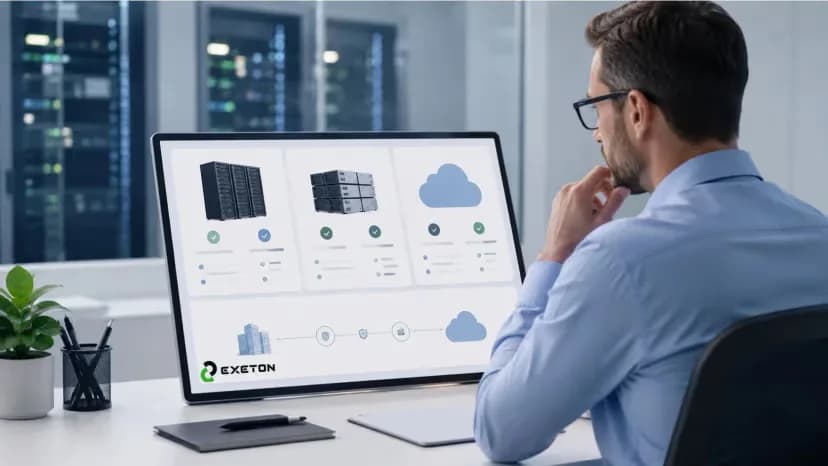
Choosing between renting compute in the cloud or purchasing physical hardware is a major strategic decision.
When to Choose the Cloud:
Ideal for exploratory AI projects, short-term model training, or highly unpredictable workloads where avoiding upfront capital expenditure is a priority.
When to Choose On-Premise:
Best for continuous, predictable production workloads. Local ownership eliminates compounding cloud premiums, guarantees compute availability, and allows data to remain entirely air-gapped for maximum security.
Recommended AI Server Solutions
Selecting the right platform depends entirely on your operational scale and deployment environment.
For Local Development and Prototyping
NVIDIA DGX Spark: A personal supercomputer form factor designed to let engineering teams build, test, and fine-tune models locally without occupying major data center cluster time.
For Densely Populated Enterprise AI Factories
Supermicro B200: Built for intense enterprise training and massive conversational AI workloads, offering top-tier compute density and advanced liquid-cooling compatibility to reduce power overhead.
For Customization and Scalable Rackmount Infrastructure
Gigabyte G893 server: A highly flexible, service-friendly platform designed to support diverse multi-GPU baseboards, flexible processor choices, and extensive storage arrays tailored to your exact data models.
Let Exeton’s Experts Architect Your Infrastructure
Navigating architectural frameworks, thermal management constraints, and multi-GPU configurations can quickly become overwhelming. You don’t have to make these high-stakes infrastructure decisions alone.
At Exeton, our highly trained and educated engineers are here to guide you through every stage of the technical evaluation process. We don’t just offer hardware; we provide deep technical clarity to ensure your investment aligns perfectly with your business goals.
Our engineering team can help you:
Analyze Your Workloads: We determine whether your software models require high-density training rigs or streamlined inference nodes.
Map True Total Cost of Ownership: We help you calculate hidden operational costs, from power delivery networks to data center floor-weight limits.
Design Thermal Strategies: Our experts explain and implement advanced cooling solutions, including Direct-to-Chip liquid cooling setups, tailored to your facility.
Future-Proof Your Scalability: We configure balanced systems that prevent processing bottlenecks, ensuring your hardware handles next-generation AI workloads seamlessly.
Conclusion
Investing in AI infrastructure is not about seeking the lowest initial price point, it is about avoiding performance bottlenecks. A properly configured system keeps your data engineering teams moving forward, while an unbalanced setup leads to underutilized resources. Matching your hardware configuration directly to your model's computational demands ensures the strongest return on investment.
Frequently Asked Questions
1. Why is there no fixed price for an AI server?
Because they are completely custom-built for specific jobs. A server running simple customer queries (inference) needs much less power and memory than a system training a massive AI model from scratch.
2. What is the biggest driver of AI hardware costs?
The GPUs. The specific generation of the chip, the number of GPUs packed into a single chassis, and the amount of ultra-fast Video RAM (VRAM) dictate the bulk of the system's cost.
3. What hidden expenses do companies usually miss?
Power and cooling. High-density GPU servers pull immense electricity and generate massive heat. Retrofitting data centers for high-power distribution and liquid cooling often costs more than the physical server itself.
4. Cloud vs. On-Premise: Which is cheaper?
The cloud is more cost-effective for short-term testing, prototyping, or unpredictable workloads. Buying physical hardware is much cheaper in the long run if you are running heavy, predictable AI applications 24/7.