



Zero-Trust AI Infrastructure: Confidential GPUs, Hardware Enclaves, VRAM Encryption, and Pipeline Security
PublishedAre you completely confident that your company's private prompts, customer records, and trade secrets remain invisible to third parties the exact second they enter an AI model?
When we evaluate data security, most of us look for lock icons on our internet browsers or password-protected files on an encrypted hard drive. But AI processing introduces a unique challenge. To process a complex query, run inference, or fine-tune an LLM, your data must be loaded directly into active system memory. For business owners and IT leaders alike, this creates a critical security question: If our data is decrypted inside system RAM to run AI, can an unauthorized process or host operator see it?
The short answer used to be a nerve-wracking "yes", especially on shared public cloud platforms. Today, building a dedicated, on-premise AI server with Exeton changes the equation. By pairing isolated physical hardware with silicon-level protection, your organization can deploy powerful AI models with zero trust issues and absolute peace of mind.
What is Zero-Trust AI Infrastructure?
Zero-Trust AI Infrastructure is a hardware-enforced security model that assumes no software, operating system, or network is automatically safe encrypting and protecting your data not only on storage drives and networks, but actively while it is being processed in computer memory.
In standard computing setups, data is protected when stored on an SSD (data at rest) and when traveling over a network (data in transit). However, once it reaches active system memory (data in use) to perform calculations, it becomes unencrypted.
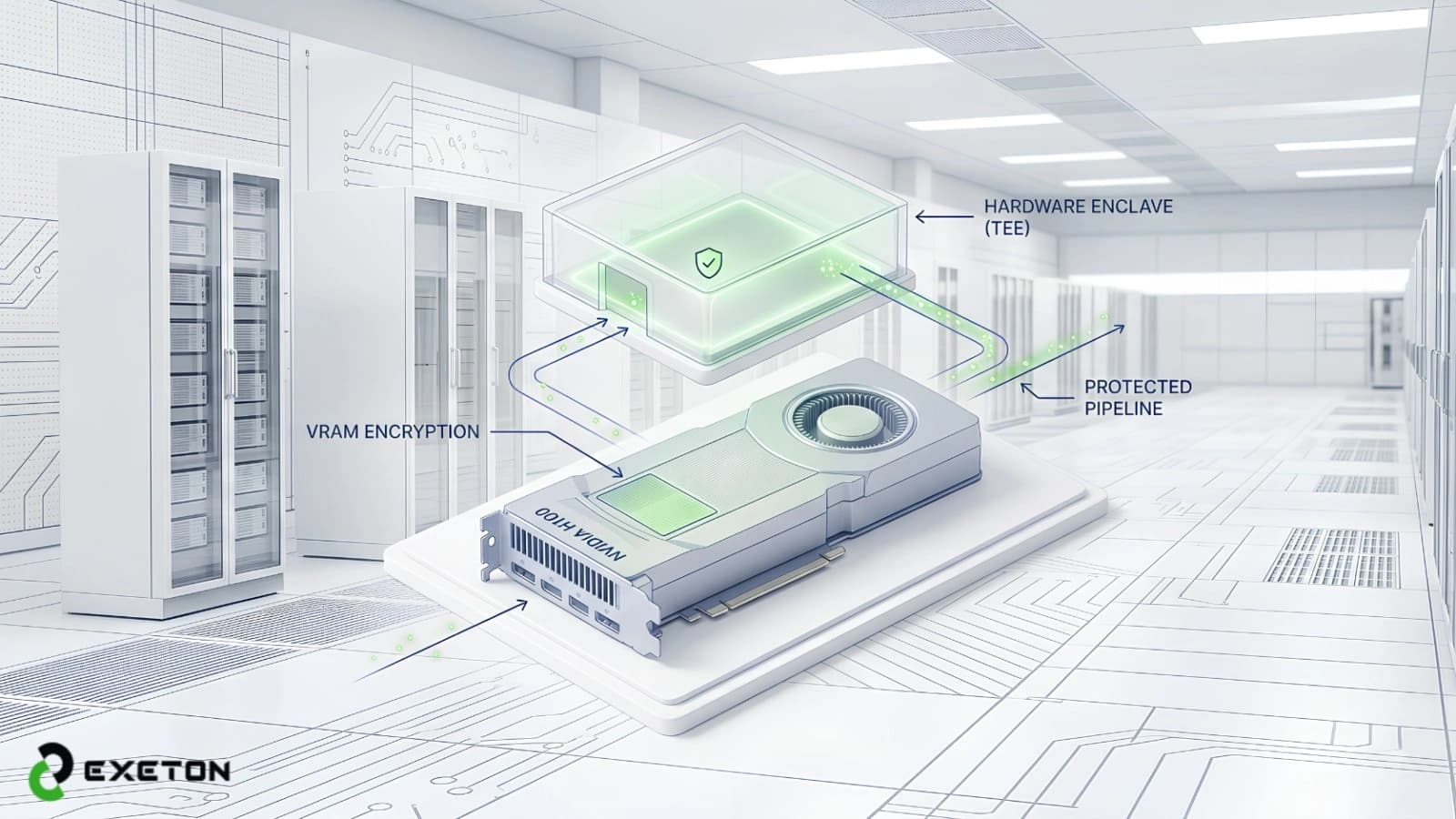
Zero-Trust AI infrastructure closes this vulnerability by placing your workloads inside a Hardware Enclave (often referred to as a Trusted Execution Environment, or TEE). Think of an enclave as a digital, cryptographic vault built directly into the processor's silicon. Even if an attacker or malicious script compromises the server's primary operating system, they cannot read the encrypted contents of the memory vault.
Why Should Your Company Build an On-Premise AI Server with Exeton?
Building a dedicated on-premise AI server with Exeton provides your business with 100% hardware ownership and complete data isolation, eliminating the privacy risks, noisy-neighbor latency, and third-party data exposures inherent to shared public cloud environments.
When relying on multi-tenant public clouds, your AI tasks execute on shared physical hardware alongside thousands of external users. While cloud providers use software to keep users separate, software can still have hidden bugs, security gaps, or settings errors that leave data exposed
Partnering with Exeton to design, build, and deploy an isolated, workload-tuned server infrastructure delivers key operational advantages:
Complete Data Ownership: Your server equipment belongs exclusively to your organization, retaining clear control over logs, access permissions, and data retention policies.
Physical & Virtual Isolation: Eliminates shared multi-tenant risks and guarantees that proprietary prompts, customer data, and custom weights never leave your physical domain.
Predictable Performance & Lower TCO: Avoids cloud queue throttling and unexpected API token charges by running unlimited local inference on high-throughput compute hardware.
Which Confidential GPUs and Systems Should Your IT Team Choose?
Modern enterprise GPU architectures from NVIDIA, including the H100, H200, B200, and GB200 platforms, feature native, hardware-enforced memory encryption designed to secure high-performance AI workloads at scale.
To help your engineering team select the ideal setup, Exeton integrates pre-validated, tier-one enterprise hardware components into custom-built AI servers. Below is a high-level comparison of leading confidential GPU options for private enterprise infrastructure:
GPU Platform | Ideal Workload Focus | VRAM Capacity | Key Security & Hardware Capability |
NVIDIA H100 | Enterprise AI inference & model training | 80 GB HBM3 | Proven Hopper architecture with native hardware confidential computing. |
NVIDIA H200 | Large Language Models (LLMs) & large contexts | 141 GB HBM3e | Higher memory capacity with active VRAM inline memory encryption. |
NVIDIA B200 | High-density generative AI & automation | 192 GB HBM3e | Next-generation Blackwell architecture featuring hardware-enforced TEEs. |
NVIDIA GB200 NVL72 | Rack-scale supercomputing & clusters | Ultra-Dense Shared Pool | Connects CPUs and GPUs in liquid-cooled racks for massive enterprise workloads. |
Whether your organization requires a high-performance local engineering workstation or a dense rack-mounted GPU cluster, exploring Exeton AI & HPC Infrastructure Solutions allows your team to evaluate custom-built platforms, such as pre-validated Supermicro, ASUS, and Dell server systems or ready to plug in Exeton GPU Clusters tailored specifically to your operational requirements.
How Does VRAM Encryption Protect Your Entire AI Pipeline?
VRAM Encryption protects your end-to-end AI pipeline by automatically scrambling data inside the GPU’s video memory, ensuring that input prompts, active calculations, and model outputs remain completely unreadable to unauthorized external processes.
When your team executes an AI workload, data travels through four primary stages in the AI Pipeline:
Input Prompts: Proprietary text, raw code, medical images, or financial datasets sent to the model.
Model Weights: The fine-tuned IP and mathematical parameters that make up your custom AI model.
Active Processing: The mathematical calculations running live within the GPU's Tensor Cores.
Output Generation: The resulting summary, prediction, generated code, or strategic analysis.
Without hardware-enforced memory encryption, an attacker with root-level system access could monitor system RAM or VRAM to extract raw prompts or steal proprietary model weights.
With confidential GPUs integrated inside an Exeton system, dedicated hardware security engines automatically encrypt data before it is written to VRAM. Data is decrypted exclusively within the processor's isolated execution cores during calculation, effectively closing memory-scraping vectors.
How Can Your IT Team Get Started with Exeton?
Your IT team can get started by consulting with Exeton's infrastructure engineers to architect, validate, and deploy a custom, turnkey(ready to plug in) AI server environment engineered for your exact workload demands.
Building a secure, zero-trust AI server does not require navigating complex hardware integration alone. Exeton manages the full infrastructure lifecycle from initial design to production deployment:
Workload-Back Architecture: Matching your AI models with optimal GPU memory, host CPUs, system RAM, and high-speed networking.
Integration & Validation: Full hardware assembly, thermal burn-in stress testing, and quality verification prior to shipment.
Deployment & Support: Turnkey rack installation, deployment services, and global SLA-backed lifecycle support.
By taking ownership of your physical infrastructure with Exeton, your organization can leverage cutting-edge Artificial Intelligence while maintaining absolute security, compliance, and control over your data.
Ready to evaluate custom hardware configurations? Visit the Exeton to speak directly with an infrastructure specialist today.
Frequently Asked Questions
How does Zero-Trust AI protect my data in memory?
It uses silicon-level hardware enclaves to automatically encrypt data inside RAM and GPU VRAM, preventing unauthorized reading even during active processing.
Will hardware VRAM encryption slow down my AI workloads?
No. Modern GPUs (like NVIDIA H100/H200/Blackwell) use dedicated, line-rate hardware encryption engines that run at full speed with negligible overhead.
Why choose an Exeton on-premise server over public cloud VPCs?
Public clouds share physical CPUs/GPUs across tenants. Exeton delivers 100% dedicated hardware isolation, removing third-party access and hypervisor risks.