



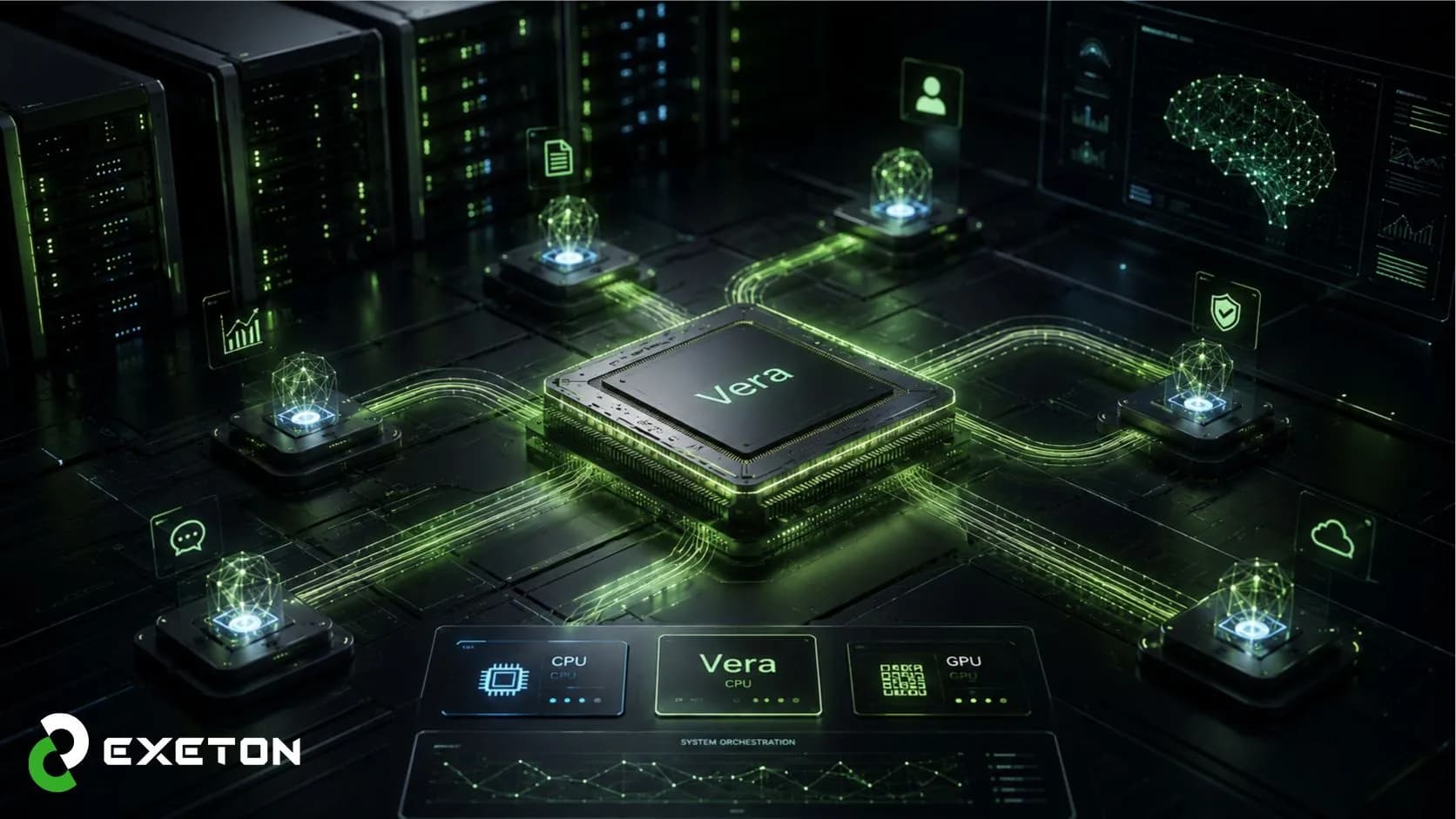
Why Nvidia's Vera CPU Announcement Matters for the Future of AI Agents
"The next AI revolution may not be about bigger models, it may be about smarter infrastructure."
For years, the conversation around artificial intelligence has focused on increasingly powerful GPUs and larger AI models. But Nvidia's recent announcement of the Nvidia Vera CPU signals an important shift in how the industry is preparing for the next phase of AI: autonomous, task-driven AI agents.
Why does Nvidia's Vera CPU matter for AI agents?
Nvidia's Vera CPU is designed to support the growing demands of AI agents by handling rapid processing, coordination, scheduling, and system-level operations while GPUs focus on AI model computation and reasoning. Together, they create a more efficient foundation for agentic AI applications at scale.
As AI moves beyond chatbots and into autonomous workflows, infrastructure becomes just as important as the models themselves. Understanding why Nvidia developed Vera helps explain where AI computing is headed, and why businesses should pay attention.
What Is Nvidia's Vera CPU?
The Nvidia Vera CPU is a next-generation processor built specifically to complement Nvidia's AI-focused GPUs within modern AI infrastructure.
Rather than competing with GPUs, Vera is designed to work alongside them.
Why Nvidia Developed Vera
As AI workloads become more complex, traditional CPU architectures can become bottlenecks. Modern AI systems require:
Faster coordination between components
Efficient data movement
Real-time task management
Improved scalability across AI servers
Nvidia developed Vera to address these challenges and optimize the performance of AI datacenter solutions.
Its Role Within AI Systems
Think of an AI system as a busy company:
The GPU acts as the specialist doing complex analytical work.
The CPU acts as the manager coordinating resources and workflows.
Vera's primary job is to ensure AI workloads move efficiently throughout the system.
How It Differs from Traditional CPUs
Traditional CPUs were designed for general-purpose computing.
The Nvidia Vera CPU is engineered specifically for AI computing environments, where massive amounts of data and thousands of simultaneous tasks must be coordinated with minimal delay.
This specialization helps unlock higher efficiency for enterprise AI deployments.
Why AI Agents Need Different Hardware Than Traditional AI Systems
The Rise of Agentic AI
The AI industry is rapidly moving toward agentic AI, systems capable of independently performing tasks, making decisions, and interacting with multiple tools.
Unlike traditional chatbots that simply respond to prompts, AI agents can:
Plan actions
Execute workflows
Access databases
Communicate with other systems
Adapt to changing conditions
For example, an AI agent could:
Read incoming emails
Schedule meetings
Update CRM records
Generate reports
Notify team members
All without human intervention.
This requires significantly more coordination than simply generating text.
The Growing Demand for AI Infrastructure
Organizations are increasingly deploying AI across multiple business functions.
Several trends are driving demand for advanced AI infrastructure:
Enterprise AI adoption
Business process automation
Multi-agent systems
Real-time decision-making
Autonomous operations
As these systems grow more sophisticated, infrastructure must support constant communication between models, applications, databases, and users.
How Vera Works Alongside Nvidia GPUs
The CPU-GPU Partnership
One of the biggest misconceptions in AI hardware is that GPUs do everything.
In reality, successful AI systems rely on both CPUs and GPUs.
What GPUs Do
GPUs are responsible for:
Training AI models
Running inference
Processing neural network computations
Performing large-scale mathematical calculations
What CPUs Do
CPUs handle:
Task scheduling
Resource allocation
Data preparation
System orchestration
Communication between components
The future of AI depends on optimizing both sides of this partnership.
Why This Matters for AI Agents
AI agents create a constant flow of actions, decisions, and interactions.
A powerful CPU like Vera can help deliver:
Faster Response Times
Agents can process and coordinate tasks more efficiently.
Better Workflow Automation
Complex business processes can run with fewer delays.
Improved Efficiency
Resources are allocated more effectively across AI servers.
Greater Scalability
Organizations can deploy larger agent networks without creating infrastructure bottlenecks.
Why Nvidia Sees a Massive Opportunity in Agentic AI
Understanding the Emerging Market
The AI industry is entering a new phase.
Rather than focusing solely on AI models, companies are investing heavily in systems that can perform work autonomously.
This includes:
Intelligent software agents
Robotics
Autonomous operations
Industrial automation
Enterprise workflow platforms
Industry leaders increasingly view AI agents as the next major growth category in artificial intelligence.
For Nvidia, supporting this shift requires building the complete AI computing stack, not just GPUs.
Potential Impact Across Industries
Agentic AI could transform nearly every industry.
Healthcare
Automated documentation
Clinical workflow support
Medical data coordination
Manufacturing
Predictive maintenance
Production optimization
Robotics management
Finance
Fraud detection
Risk assessment
Automated compliance monitoring
Software Development
AI coding assistants
Automated testing
DevOps automation
Customer Service
Multi-step issue resolution
Intelligent support workflows
Personalized customer interactions
What This Means for Businesses Investing in AI
Infrastructure Planning
Businesses evaluating AI initiatives should think beyond models alone.
The effectiveness of AI systems increasingly depends on infrastructure design.
Organizations must consider:
Compute resources
Networking
Storage
Data pipelines
System orchestration
AI Server Requirements
Modern AI servers need balanced architectures.
The most effective deployments combine:
High-performance CPUs
Advanced GPUs
Fast networking
Scalable storage
This balance becomes especially important as AI agents handle more complex workloads.
Scalability Considerations
Future-proofing AI investments means preparing for increasing demand.
Businesses should evaluate:
Growth in AI workloads
Multi-agent deployments
Data volume expansion
Real-time processing requirements
Infrastructure decisions made today can determine AI performance for years to come.
Key Takeaways
Nvidia Vera CPU is a specialized processor designed to support advanced AI infrastructure.
AI agents require fast coordination and task management beyond traditional chatbot workloads.
Vera complements Nvidia GPUs by handling system orchestration and operational tasks.
Nvidia sees significant growth opportunities in agentic AI and autonomous systems.
Businesses should begin planning AI infrastructure that balances CPUs, GPUs, networking, and storage for future scalability.
Frequently Asked Questions
What is Nvidia Vera CPU?
Nvidia Vera CPU is a next-generation processor designed to work alongside Nvidia GPUs in AI infrastructure, improving coordination, task management, and system efficiency.
Why do AI agents need specialized hardware?
AI agents perform multiple tasks simultaneously and interact with various systems. Specialized hardware helps manage these complex workflows efficiently and at scale.
How is Vera different from traditional CPUs?
Traditional CPUs are general-purpose processors. Vera is optimized specifically for AI computing environments and large-scale AI workloads.
Can Vera replace GPUs?
No. Vera and GPUs serve different purposes. GPUs perform AI model computation and reasoning, while Vera manages coordination, scheduling, and supporting operations.
What industries will benefit most from agentic AI?
Healthcare, manufacturing, finance, software development, and customer service are among the industries expected to see significant benefits from AI agents.
Conclusion
The announcement of the Nvidia Vera CPU highlights an important reality about the future of AI: infrastructure is becoming just as critical as the models themselves.
As AI agents evolve from simple assistants into autonomous systems capable of managing complex workflows, organizations will need AI hardware designed to support continuous coordination, rapid decision-making, and large-scale automation. That is exactly the challenge Nvidia is addressing with Vera.
For businesses investing in enterprise AI, the message is clear. The future of AI agents will depend not only on smarter models but also on smarter infrastructure. High-performance AI servers, balanced CPU-GPU architectures, and scalable AI datacenter solutions will become essential building blocks for long-term success.
At Exeton, we help organizations navigate the evolving world of AI infrastructure, high-performance computing, and enterprise-ready AI hardware solutions designed for the next generation of intelligent systems.