



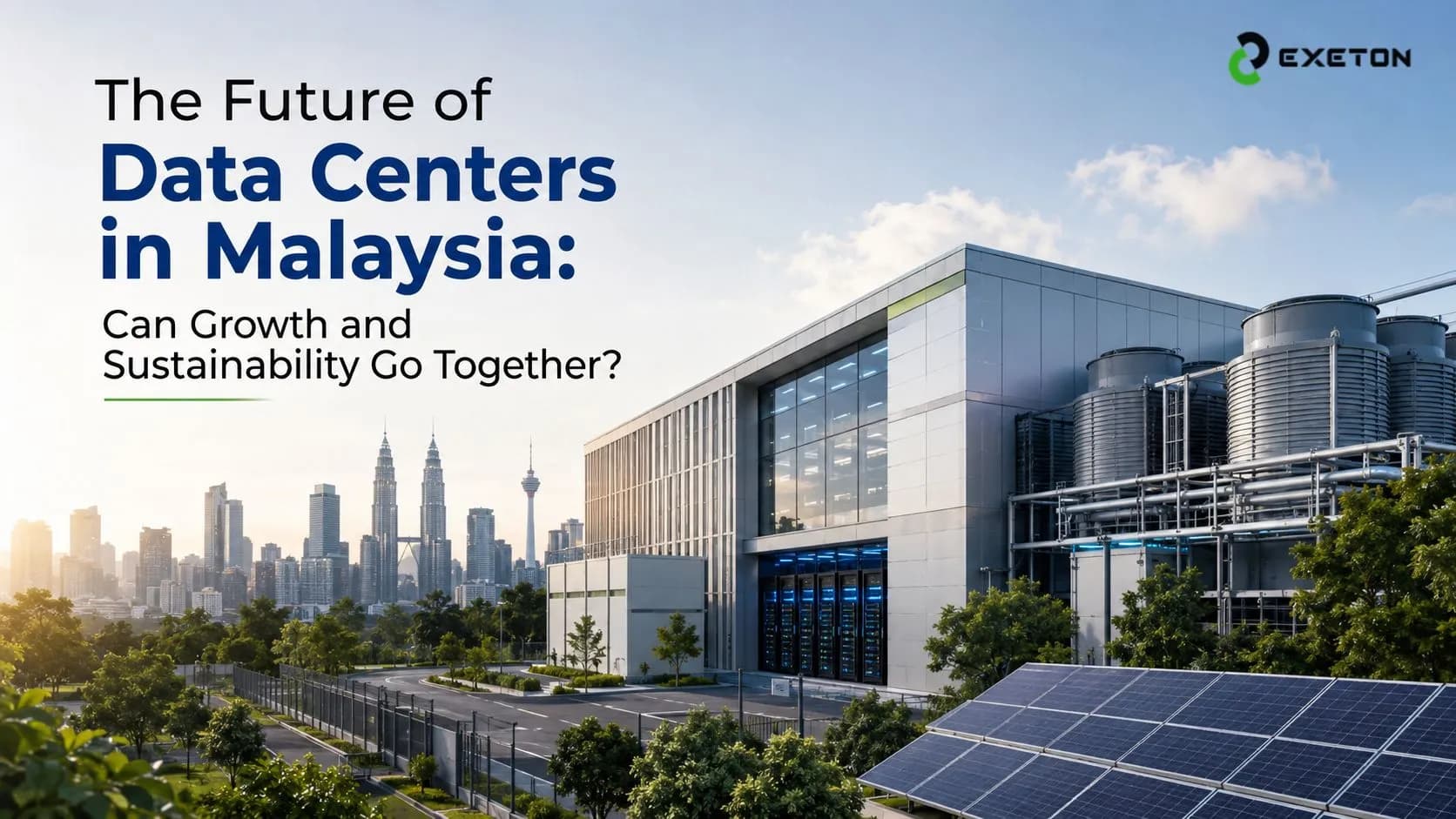
The Future of Data Centers in Malaysia: Can Growth and Sustainability Go Together?
Every AI interaction we experience, from instantaneous search answers to generating complex analytical models, depends on an invisible foundation: data centers. As artificial intelligence transitions from a novelty into an essential component of global business, the demand for massive computing power has surged exponentially.
Southeast Asia has become a primary staging ground for this infrastructure boom, with Malaysia emerging as one of the region's fastest-growing digital hubs. Yet, this rapid expansion brings a crucial challenge into focus: balancing intense energy and water demands with national sustainability goals.
Supporting this transformation requires robust, scalable technology behind the scenes. Exeton empowers businesses with data center maintenance, AI hardware, deep learning systems, and high-performance server solutions. Exeton delivers advanced GPU technologies and AI infrastructure solutions that help organizations accelerate innovation efficiently.
Why Is Malaysia Becoming a Major Data center Hub?
Companies are investing heavily in Malaysia because it offers an optimal combination of strategic location, competitive land and power costs, robust submarine cable connectivity, and strong government support for digital infrastructure.
Positioned directly adjacent to Singapore, Malaysia, particularly southern hubs like Johor and established ecosystems in Cyberjaya, provides low-latency access to major Asian markets at a fraction of the cost. When Singapore instituted a multi-year moratorium on new facilities due to land and power constraints, international tech giants and hyperscalers quickly recognized Malaysia as the natural choice for expansion.
Drivers of Malaysia's Boom | |
Geographic Proximity to SG | Low latency across SEA |
Competitive Land & Power | Cost-effective scaling |
Favorable Government Policy | Digital Malaysia (MD) |
Expanding Fiber & Submarine | Global connectivity |
Furthermore, initiatives like the Malaysia Digital (MD) status offer targeted tax incentives, making it an attractive environment for building next-generation infrastructure.
What Challenges Come With Rapid Data center Growth?
A modern AI data center is far more than a warehouse filled with computer racks. It functions as the virtual "engine room" of the digital economy, requiring immense continuous power and cooling resources. Rapid expansion introduces several critical pressures:
Challenge | Why It Matters |
Energy Consumption | Advanced AI workloads require high-density racks drawing significantly more power than standard cloud servers, putting pressure on local power grids. |
Water Usage | Traditional evaporative cooling systems require millions of liters of water daily, straining regional municipal supplies. |
Infrastructure Demand | Transmission lines, substations, and local utilities must rapidly upgrade to keep pace with multi-megawatt facilities. |
Environmental Impact | Reliance on fossil-fuel-heavy energy grids can complicate long-term carbon reduction targets unless paired with clean power. |
Navigating these challenges requires moving away from legacy infrastructure toward engineered,
highly efficient systems.
How Can Data centers Become More Sustainable?
The industry is shifting toward responsible infrastructure design, proving that growth and environmental care do not have to be mutually exclusive.
1. Energy-Efficient Computing
Silicon design has made massive leaps. Modern graphics processing units (GPUs) and specialized server architectures perform far more operations per watt than older equipment. By upgrading to dense, accelerated hardware, data centers process larger workloads using fewer total physical nodes, reducing energy overhead.
2. Smarter Cooling Technologies
Cooling represents a significant portion of a facility’s power draw. Operators are moving away from water-intensive air conditioning toward closed-loop liquid cooling and direct-to-chip cooling systems. These approaches transfer heat away from processors with far greater precision, dramatically reducing both power consumption and water waste.
3. Renewable Energy Adoption
Corporate Renewable Energy Supply Schemes (CRESS) and long-term Power Purchase Agreements (PPAs) are expanding in Malaysia. Developers are increasingly pairing new builds with dedicated solar arrays and battery energy storage, helping power computing clusters with clean energy.
What Does the Future of AI Infrastructure Look Like?
The next generation of computing facilities will prioritize performance and efficiency equally. Rather than focusing solely on physical size, future developments will emphasize intelligent workload allocation, scalable cluster architectures, and optimized thermal management.
This transition requires hardware tailored for high-density computing. Exeton supports this evolving ecosystem by delivering custom AI hardware solutions, data center maintenance, deep learning systems, and enterprise-grade, high-performance servers. By partnering with leading technology providers like NVIDIA, Exeton ensures that organizations can deploy GPU technologies designed for intensive workloads without sacrificing operational efficiency.
How Can Businesses Prepare for the AI Infrastructure Era?
Navigating this transition requires thoughtful planning. Organizations seeking to deploy or scale AI capabilities should consider four strategic steps:
Understand Specific AI Requirements: Training large language models demands vastly different compute architectures than running lightweight inference. Matching hardware to the exact workload prevents unnecessary energy expenditure.
Choose Scalable Solutions: Deploy modular rack setups that allow step-by-step expansion as computational needs grow, avoiding over-provisioning upfront.
Prioritize System Efficiency: Focus on energy-efficient servers, high-efficiency power supplies, and advanced thermal management to manage long-term operating costs and environmental impact.
Work With Experienced Partners: Designing, deploying, and maintaining high-density compute clusters requires deep domain expertise. Technical partners help ensure systems are configured correctly from day one.
Conclusion
Malaysia’s rapid emergence as a regional data center hub offers enormous economic potential. However, long-term success will be defined by how effectively facilities integrate sustainable practices. Building larger facilities is no longer enough, the focus must shift toward building smarter, highly efficient infrastructure.
With years of experience, Exeton delivers data center maintenance, AI hardware, GPU solutions, servers, and high-performance computing technologies globally, supporting organizations as they build the infrastructure needed for the future of AI.
Frequently Asked Questions
1. Why is Malaysia becoming a popular location for data centers?
Malaysia offers strategic proximity to major Asian markets, low-latency connectivity, competitive operating costs, and ample land. Strong government policies like Malaysia Digital (MD) status further encourage global tech firms and hyperscalers to establish regional hubs in areas like Johor and Cyberjaya.
2. How much energy do AI data centers consume?
AI data centers require significantly more power than traditional cloud facilities due to high-density compute clusters. Large facilities can draw anywhere from 50 megawatts to several hundred megawatts, with individual high-performance AI server racks consuming up to 40–100 kW or more per rack.
3. How can data centers reduce their environmental impact?
Facilities reduce impact by adopting high-efficiency GPU hardware, implementing liquid cooling systems, and utilizing closed-loop water designs. Additionally, operators are increasingly sourcing power through renewable energy schemes like solar power purchase agreements (PPAs) and modular power management systems.
4. Why is AI infrastructure important for businesses?
AI infrastructure provides the specialized processing power, high-speed networking, and memory capacity necessary to run complex algorithms efficiently. Having optimized, scalable hardware ensures companies can process massive datasets rapidly, run advanced models, and remain competitive without incurring unsustainable energy costs.