



How to Choose a Trusted AI Infrastructure Partner: The Role of Quality, Security, and Business Continuity Certifications
When you scale up AI infrastructure, you aren't just buying more computers; you are dealing with a totally different beast.
A standard vendor can ship you the boxes, but they often leave you to figure out the chaos that happens next. A single modern GPU server pulls more power and generates more heat than entire racks of traditional servers. If the power supply isn't perfectly calculated, or if the cooling setup is slightly off, the hardware will throttle itself to prevent melting. You end up with incredibly expensive silicon running at a fraction of its capacity or worse, crashing mid-run.
An experienced engineering partner doesn't just deliver the hardware; they know how to actually stitch it into your data center. They test the firmware combinations before the kit arrives, optimize the ultra-fast networking that keeps the nodes talking, and ensure your facility can handle the electrical load.
The Growing Need for Reliable AI Infrastructure Partners
The demand for massive compute power has shifted enterprise IT from traditional CPU architectures to dense, power-hungry GPU servers. Traditional data centers were built for predictability; AI infrastructure is built on extremes. Managing these advanced systems requires specialized knowledge in high-density power delivery, liquid cooling, and ultra-low-latency networking.
The Reality of Modern GPU Clusters
Unlike standard CPU servers that distribute loads evenly, a single modern GPU server can pull as much power and generate as much heat as an entire row of legacy hardware. Without precise engineering like closed-loop liquid cooling and intelligent Power Distribution Units (PDUs), localized hot spots can cause immediate hardware throttling or thermal shutdowns.
Key Points:
Modern GPU clusters require advanced cooling and power management.
AI training relies on thousands of GPUs acting as a single unit.
Ultra-low-latency networks like NVIDIA Quantum InfiniBand prevent synchronization delays.
A single delayed data packet can stall the entire cluster, wasting compute cycles.
The Challenge of Configuration Drift and Lifecycle Scaling
AI infrastructure is not a "set-and-forget" deployment. As clusters grow from a few initial nodes to massive production environments, maintaining hardware consistency becomes an operational challenge.
Key Points:
Hardware consistency is difficult to maintain as AI clusters scale.
Firmware mismatches, outdated NIC drivers, or unverified OS patches can destabilize the entire cluster.
Unverified vendors may leave teams responsible for ongoing maintenance and hardware issues.
Complex driver updates and part replacements can disrupt the AI software stack.
The Risks of Unverified Vendors
Traditional hardware resellers treat these systems like standard logistics shipments. Choosing a vendor without verified expertise introduces severe risks:
Costly Downtime: When a cluster stalls mid-run due to an unoptimized network topology or thermal throttling, it costs thousands in wasted developer time and delayed time-to-market.
Supply Chain Vulnerabilities: Lacking certified supply chain custody opens the door to unvetted distribution channels or component mismatches that compromise hardware integrity.
Integration Failures: Standard IT integrators often lack the high-performance computing (HPC) staging experience required to configure complex, interconnected cluster architectures.
What Makes an AI Infrastructure Partner Reliable?
A dependable infrastructure partner bridges the gap between raw hardware components and a stable production environment.
Core Pillar | Operational Impact |
Technical Expertise | Deep understanding of GPU clustering, thermal dynamics, and high-speed interconnects. |
Security Practices | Strict data governance and physical security protocols across the entire supply chain. |
Service Management | Predictable SLA frameworks for ongoing maintenance, patch management, and hardware replacement. |
Business Continuity | Documented disaster recovery plans to ensure project completion despite market disruptions. |
Why ISO Certifications Matter When Choosing a Technology Partner?
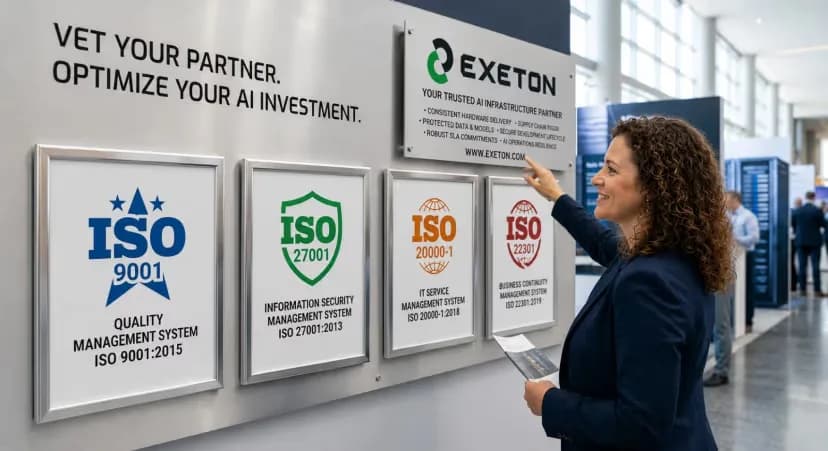
Vetting an infrastructure provider on their self-proclaimed expertise is highly risky. Independent, globally recognized ISO certifications offer objective proof that a vendor consistently follows industry best practices.
ISO 9001:2015 - Commitment to Quality Management
This certification proves a partner uses strict quality control processes. For AI hardware, this means every server configuration, component integration, and cable layout undergoes rigorous testing before deployment, reducing dead-on-arrival (DOA) hardware incidents to near zero.
ISO/IEC 27001:2022 - Protecting Information and Infrastructure
AI workloads handle proprietary corporate data, intellectual property, and sensitive customer models. An ISO 27001 certification confirms the partner enforces rigorous information security controls across their facilities, networks, and personnel, protecting your infrastructure from supply chain attacks.
ISO/IEC 20000-1:2018 - Professional IT Service Management
Deploying AI infrastructure is not a one-time transaction; it requires ongoing lifecycle management. This standard ensures your partner has structured IT service frameworks in place to handle incident responses, hardware upgrades, and performance troubleshooting efficiently.
ISO 22301:2019 - Ensuring Business Continuity
Global supply chains for AI hardware remain highly volatile. This certification guarantees the partner has a resilient operational strategy to withstand geopolitical shifts, natural disasters, or power grid failures without derailing your deployment timeline.
Why Certifications Matter for AI Hardware and GPU Infrastructure Projects
AI hardware installations operate under extreme conditions. A single node in a GPU cluster can draw more power than an entire rack of legacy servers. Without strict process controls mandated by ISO standards, integration errors can multiply quickly.
AI hardware deployments require precise installation and process control.
Certified processes ensure proper PDU calculations, network testing, and secure key handling.
ISO standards help reduce integration risks in high-performance AI environments.
Certifications transform unpredictable hardware deployments into repeatable engineering milestones.
Frequently Asked Questions
Why should businesses choose an ISO-certified AI infrastructure provider?
ISO certifications provide independent verification that a partner adheres to standardized, auditable processes for quality, security, and resilience, significantly reducing deployment and operational risks.
What ISO certifications are most critical for technology partners?
Look for ISO 9001 (Quality), ISO/IEC 27001 (Information Security), ISO/IEC 20000-1 (IT Service Management), and ISO 22301 (Business Continuity). Together, these form a complete framework for reliable infrastructure delivery.
How do certifications protect AI data security?
Certifications like ISO 27001 ensure that the partner implements strict access controls, physical security protocols, and secure data handling processes, preventing unauthorized exposure of proprietary AI models and training data.
How do certifications help enterprise technology projects stay on schedule?
Certifications like ISO 9001 and ISO 22301 help projects stay on schedule through proper planning, documentation, and risk management, ensuring smoother deployments and fewer unexpected delays.
What is the role of ISO 20000-1 in ongoing AI hardware maintenance?
ISO/IEC 20000-1 ensures AI hardware maintenance follows a structured and reliable process. It helps manage firmware updates, replacements, and configuration changes systematically, reducing risks and keeping AI clusters stable over time.
Exeton: Building the Future of AI with Trusted Infrastructure
At Exeton, we build the foundations that power enterprise intelligence. As a specialized provider of AI hardware, GPU servers, and high-performance computing solutions, we align our operations with rigorous global standards.
Our deep expertise in NVIDIA partner solutions allows us to design, deploy, and maintain dense data center architectures tailored for demanding workloads. By embedding ISO-compliant quality, security, and continuity frameworks into our engineering DNA, Exeton ensures your AI investments remain secure, scalable, and highly available.