


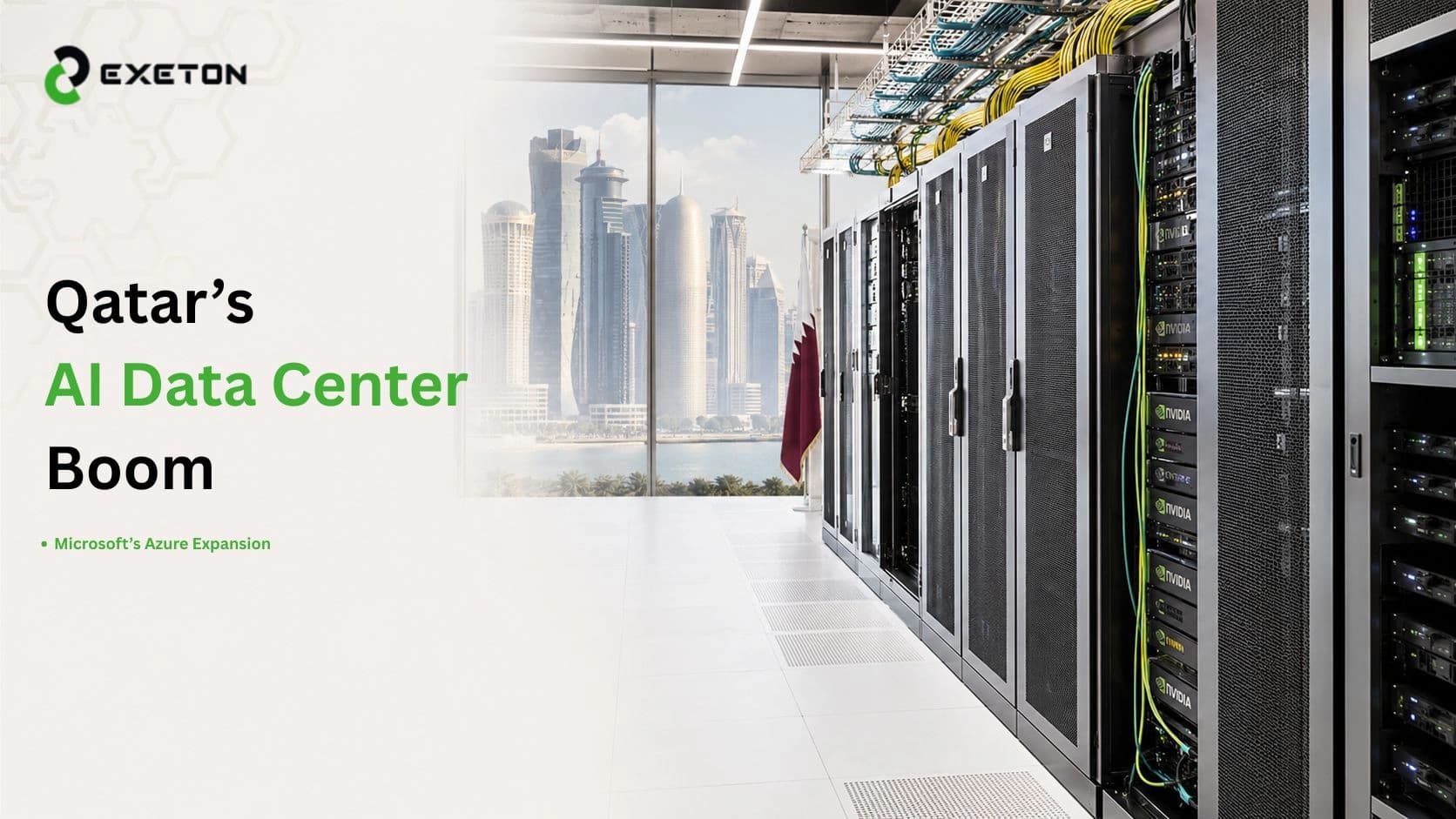
Qatar’s AI Data Center Boom: What Microsoft’s Azure Expansion Means for GPU Infrastructure
Article Summary
Qatar is rapidly increasing data-center capacity to support growing cloud, AI and data-intensive workloads.
AI workloads require far more than physical data-center space: GPU servers, high-speed networking, storage, cooling and reliable power all have to work together.
Purpose-built AI/HPC infrastructure helps turn data-center capacity into usable compute for training, inference, research and enterprise AI.
What happens when a country starts building data-center capacity faster than traditional enterprise computing can consume it?
The answer may be increasingly visible in Qatar, where data-center operators are adding capacity for cloud, artificial intelligence and high-performance computing. MEEZA, for example, delivered a 4MW expansion to a global hyperscaler in June 2026, while the company has also announced a separate 6MW agreement supporting cloud and AI workloads. In September 2026, MEEZA announced another 8MW hyperscaler agreement.
Microsoft Azure is an important part of Qatar's cloud infrastructure landscape. Microsoft's Azure Qatar Central region has been operating since 2022 and supports data residency in Qatar.
But the bigger story is not simply the number of megawatts being added. It is what those megawatts eventually power.
For organizations planning AI and HPC deployments, this distinction matters. Exeton works at that infrastructure layer, combining GPU servers, networking, storage, cooling and integration for demanding AI and high-performance computing environments.
Why is Qatar investing so heavily in data-center capacity?
Several forces are pushing Qatar's data-center expansion.
Cloud adoption is one. Enterprises and government organizations increasingly depend on locally available computing resources for applications, analytics and digital services. AI adds another layer of demand because training and running modern models can require substantially more computing power than conventional business applications.
Data sovereignty also matters. Keeping workloads and data within a specific country can simplify regulatory, security and governance requirements for organizations handling sensitive information.
Qatar's strategy is therefore not simply about constructing more server rooms. It is about creating infrastructure capable of supporting cloud platforms, AI, HPC and other data-intensive services.
One useful way to understand the difference is to separate facility capacity from computing capability:
Data-Center Capacity | What It Represents |
MW of Power | Computing capacity the facility can support |
GPU Infrastructure | Actual AI processing capability |
Networking | How quickly GPUs communicate |
Storage | Where training data and models are stored |
Cooling | How high-density compute stays operational |
A megawatt is therefore an important starting point, but it does not tell you how much AI work a facility can actually perform.
Why does AI need different infrastructure from a traditional data center?
Traditional enterprise applications often rely heavily on CPUs. AI workloads make much greater use of GPUs because GPUs are designed to perform many calculations in parallel.
That makes them particularly effective for workloads such as neural-network training, scientific computing and high-throughput inference.
The difference becomes significant at scale.
An AI cluster may contain multiple GPU servers connected through very high-speed networking. During model training, those GPUs constantly exchange data. If the network is too slow, the expensive processors spend time waiting rather than computing.
Storage matters for the same reason. Large datasets need to be delivered to the GPUs quickly enough to keep the cluster productive.
Power and cooling become equally important. High-density GPU systems can draw substantially more power and produce more heat than conventional servers.
This leads to a simple principle:
A large data center is not automatically an AI-ready data center.
The facility needs an infrastructure design capable of supporting sustained GPU workloads.
What does Microsoft Azure’s Qatar expansion tell us about the market?
Microsoft's presence in Qatar illustrates why local cloud infrastructure matters. Azure's Qatar Central region provides a regional cloud location with data stored at rest in Qatar, giving organizations another option for workloads where location, latency and regulatory requirements are important.
At the same time, it is important not to assume that every MEEZA hyperscaler agreement is a Microsoft contract. MEEZA has publicly described its customers in these announcements only as global hyperscalers or cloud providers.
The broader market signal is nevertheless clear: hyperscale cloud demand is creating a need for substantial, long-term data-center capacity.
AI strengthens that demand because AI services can require large pools of accelerated compute, high-bandwidth networking and substantial storage.
For Qatar, the geographic position is also relevant. A strong local infrastructure base can support organizations across the region that need lower latency, local data handling and additional resilience alongside global cloud resources.
What GPU infrastructure is required behind the scenes?
Think of an AI data center as a chain:
Power → racks → GPU servers → networking → storage → cooling → software → monitoring
Power: The facility must provide enough electrical capacity for dense computing and maintain reliable operation.
GPU servers: These provide the accelerated compute used for AI training, inference and HPC workloads.
Networking: High-speed Ethernet or InfiniBand connects GPUs and servers so distributed workloads can operate efficiently.
Storage: High-performance NVMe and parallel storage systems feed datasets and model checkpoints to compute nodes.
Cooling: Dense GPU systems require carefully engineered thermal management, which can include advanced air or liquid-cooling approaches.
Software: Drivers, orchestration, AI frameworks and cluster management turn hardware into a usable computing environment.
Monitoring: Operators need visibility into performance, power, temperatures, failures and utilization.
This is where specialized infrastructure engineering becomes important. Exeton's AI/HPC approach combines accelerators, high-speed networking, high-performance storage and engineering support, with solutions ranging from individual GPU systems to multi-node clusters.
What could Qatar’s expansion mean for global AI infrastructure?
Qatar's development is part of a wider Gulf trend toward greater AI and digital infrastructure capacity.
As more regional compute becomes available, enterprises may have more options for where they train models, run inference and process sensitive datasets. That can support sovereign AI strategies, regional cloud services and enterprise AI adoption.
It also changes how organizations evaluate infrastructure.
The question is no longer simply, "Where can we put more servers?"
It becomes: Where can we deploy enough compute, power, networking, storage and cooling to run AI reliably at the required scale?
That shift is important well beyond Qatar. Similar infrastructure decisions are emerging across the Middle East and other markets where governments and enterprises are investing in AI capability.
Where does Exeton fit into the AI infrastructure stack?
Exeton operates at the layer between individual hardware components and complete AI/HPC environments.
Its infrastructure offering includes GPU servers, HPC systems, high-speed networking, storage, rack-level integration, cooling and deployment support. Its integration services cover hardware assembly, accelerator and storage installation, networking, testing, validation and rack-scale deployment.
For an organization building an AI environment, that means the focus can move beyond selecting a GPU toward designing a complete system around the workload.
That distinction becomes increasingly important as clusters grow. A collection of powerful servers is not necessarily a well-designed AI infrastructure platform. Compute, networking, storage, power and thermal management have to be engineered as one system.
Conclusion
Qatar's data-center boom is ultimately an AI infrastructure story.
Adding megawatts creates the physical foundation for more digital capacity, but those megawatts only become useful AI compute when they are connected to the right servers, GPUs, networking, storage, cooling and software.
Microsoft Azure's established presence in Qatar and MEEZA's expanding hyperscaler capacity illustrate the broader direction of the market: regional infrastructure is being built to support increasingly demanding cloud and AI workloads.
As Qatar and the wider Gulf continue expanding their digital infrastructure, organizations will increasingly need AI-ready environments rather than conventional server capacity. Exeton's role is to help design and integrate that underlying compute infrastructure, turning physical data-center capacity into practical platforms for AI, HPC and the next generation of demanding workloads.