



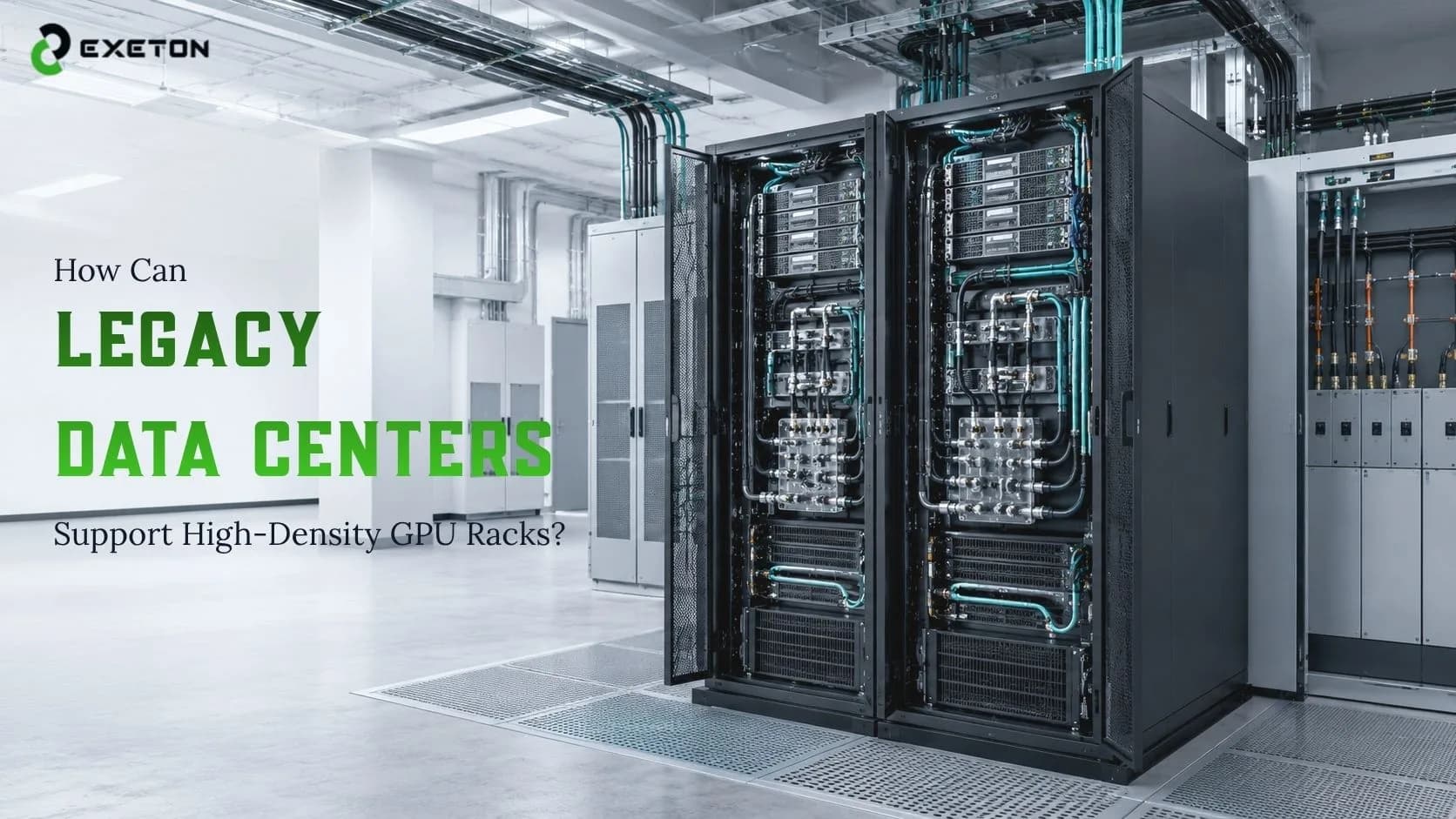
How Can Legacy Data Centers Support High-Density GPU Racks?
PublishedArtificial Intelligence is driving one of the fastest infrastructure transformations in enterprise technology. According to recent industry surveys, over 80% of organizations are expanding their investments in AI compute to keep pace with demand.
To power these applications, businesses rely on high-performance GPU systems. However, dropping dense GPU hardware into older facilities designed years ago introduces practical challenges around power management, localized cooling, floor loads, and networking throughput.
Building a brand-new data center can take up to three years and significant capital expenditure. Fortunately, there is a much faster, cost-effective alternative: modernizing your existing footprint. With targeted infrastructure retrofits, legacy data centers can safely, reliably, and efficiently host high-density AI clusters.
At Exeton, we specialize in simplifying this transformation. We supply enterprise AI server hardware, engineer custom L6-L12 rack integrations, and deliver end-to-end deployment services that make upgrades effortless for IT engineers and purchasing managers alike.
Why Can’t Standard Air Cooling Keep Up with High-Density GPU Clusters?
Traditional room air conditioning fails at high rack densities because air lacks the volumetric heat capacity to remove extreme thermal energy from dense GPU silicon.
Standard Computer Room Air Handler (CRAH) units rely on cold-aisle/hot-aisle airflow, which becomes inefficient once rack density exceeds 20 kW per rack. Attempting to cool dense GPU servers with ambient room air leads to thermal throttling, where processors automatically reduce clock speeds to prevent hardware damage, resulting in reduced compute performance and wasted CAPEX.
The Shift to Direct Liquid Cooling (DLC)
Liquid transfers thermal energy over 25 times more effectively than air. Retrofitting a legacy facility for high-density compute typically involves three primary cooling architectures:
Direct-to-Chip Cooling (DLC): Closed-loop cold plates sit directly on the GPUs and CPUs. Liquid coolant absorbs heat directly at the silicon junction before circulating through a dedicated Coolant Distribution Unit (CDU).
Rear-Door Heat Exchangers (RDHx): A specialized fluid-fed radiator panel replaces the rear door of the rack cabinet, trapping and neutralizing hot exhaust before it enters the room airflow.
Immersion Cooling: Server nodes are completely submerged in non-conductive dielectric fluid, removing internal server fans and drastically lowering overall PUE (Power Usage Effectiveness).
Through Exeton’s full-stack integration services, engineering teams can configure and validate liquid-ready GPU server architectures that align directly with existing facility plumbing and cooling infrastructure.
How Do You Upgrade Power Distribution to Prevent Cable Clutter and Thermal Loss?
Upgrading power delivery requires transitioning internal distribution from low-voltage AC to higher-voltage, three-phase power (such as 415V AC or 800V DC) to minimize amperage and conductor size.
Attempting to feed a 60 kW GPU rack with traditional 208V single-phase power requires thick copper cables that restrict rear-rack airflow, increase physical weight, and generate waste heat due to resistive losses ($I^2R$ loss).
Essential Electrical Retrofits
1. High-Voltage Distribution:
Moving to 415V AC or 800V DC distribution lowers required amperage per feed, keeping power cabling manageable while improving overall energy efficiency.
2. Smart High-Density PDUs:
Implementing three-phase, 60A to 100A intelligent rack PDUs with outlet-level metering and remote power cycling.
3. Dynamic UPS Balancing:
Upgrading to modular Lithium-Ion Uninterruptible Power Supply (UPS) topologies capable of absorbing rapid load swings typical of large-scale model training.
How Do You Reinforce Legacy Flooring for 4,000+ lb GPU Racks?
A fully populated high-density GPU rack can weigh between 3,000 and 4,500 lbs (1,360 to 2,000+ kg), easily exceeding standard raised-floor static ratings (typically capped around 1,500 lbs).
Modern AI servers combine heavy-duty power supplies, dense copper busbars, cold plates, and high-performance server nodes into a compact 24-inch footprint.
Infrastructure Vector | Standard Enterprise Rack | Modern AI GPU Rack (Retrofit) |
Power Density | 5 kW - 10 kW / rack | 40 kW - 100+ kW / rack |
Thermal Management | Forced Air / Hot-Aisle Containment | Direct-to-Chip Liquid (DLC) / RDHx |
Total Enclosure Weight | < 1,500 lbs (680 kg) | 3,000 – 4,500+ lbs (1,360 – 2,000 kg) |
Interconnect Fabric | 10G / 25G Ethernet | 400G / 800G InfiniBand or RoCE v2 |
Structural Load Engineering Solutions
Ground-Level Slab Placement: Deploying high-density GPU clusters directly onto concrete slab floors where weight limits are virtually non-existent.
Steel Load-Spreading Plates: Positioning structural steel plates under cabinet levelling feet to distribute point loads across sub-floor pedestals and joists.
Heavy-Duty Enclosure Frames: Utilizing heavy-duty industrial rack enclosures certified for high static and dynamic transport weights.
What Networking Architecture Prevents GPU Bottlenecks?
To maximize GPU utilization, legacy networking fabrics must be upgraded to ultra-low-latency 400Gbps or 800Gbps optical interconnects utilizing InfiniBand or RDMA over Converged Ethernet (RoCE v2).
GPUs process complex matrix calculations in parallel. If data fabrics experience high latency or packet loss, expensive GPU cores sit idle waiting for synchronization, a situation known as "GPU starvation."
(800G) --> Lossless RDMA / RoCE v2 --> 100% GPU Utilization
High-Throughput Fabric Upgrades
InfiniBand vs. RoCE v2: InfiniBand delivers hardware-based, lossless flow control preferred for large-scale distributed training; high-speed Ethernet with RoCE v2 provides an open, scalable fabric for enterprise AI inferencing.
Non-Blocking Leaf-Spine Topologies: Designing flat network fabrics where every GPU node maintains equal hop counts and latency to all spine switches.
Optical Interconnects: Upgrading to high-density Active Optical Cables (AOC) and MTP/MPO fiber trunking to maintain clean internal cabling routing and unobstructed rear exhaust paths.
Retrofitting vs. New Construction: Accelerating Time-to-Value
Updating an existing data center offers a significantly faster operational timeline (months instead of years) while preserving capital for actual compute investments.
By retrofitting power distribution, integrating direct-to-chip liquid cooling, reinforcing floor loading, and upgrading high-speed networking, legacy data centers can host tier-one AI server architectures seamlessly.
with Exeton --> Operational in Months --> Capital Reserved for Compute
Streamline Your Infrastructure Modernization with Exeton
Deploying enterprise AI computing requires a coordinated strategy across hardware procurement, system assembly, and physical site readiness. To eliminate complexity for engineering leads and procurement officers, Exeton delivers end-to-end AI infrastructure services:
Enterprise Hardware Supply: Direct integration of top-tier AI and GPU platforms (NVIDIA, Supermicro, GIGABYTE, AMD).
Precision L6-L12 Integration: Custom component assembly, GPU/accelerator mounting, rack burn-in testing, and pre-validated system delivery.
Turnkey Deployment & Support: On-site rack and stack, high-density power/cooling alignment, and SLA-backed maintenance to ensure maximum operational uptime.
Whether modernizing an existing enterprise facility or expanding a high-density cluster, Exeton provides the hardware, engineering, and deployment support needed to accelerate your AI strategy.
Contact the engineering team at Exeton today to schedule an infrastructure assessment and evaluate your data center's readiness for high-density GPU compute!
Frequently Asked Questions (FAQs)
What defines a "high-density" GPU rack?
Traditional racks use 5-10 kW. Modern high-density AI environments start at 20 kW and routinely reach 40 kW to 120+ kW per rack.
Is direct liquid cooling safe inside servers?
Yes. Systems use non-conductive fluids, dry-break quick disconnects, and real-time leak-detection shutoff valves.
How does Exeton assist with retrofits?
Exeton provides hardware sourcing, liquid-ready L6-L12 rack assembly, and complete on-site deployment services.