


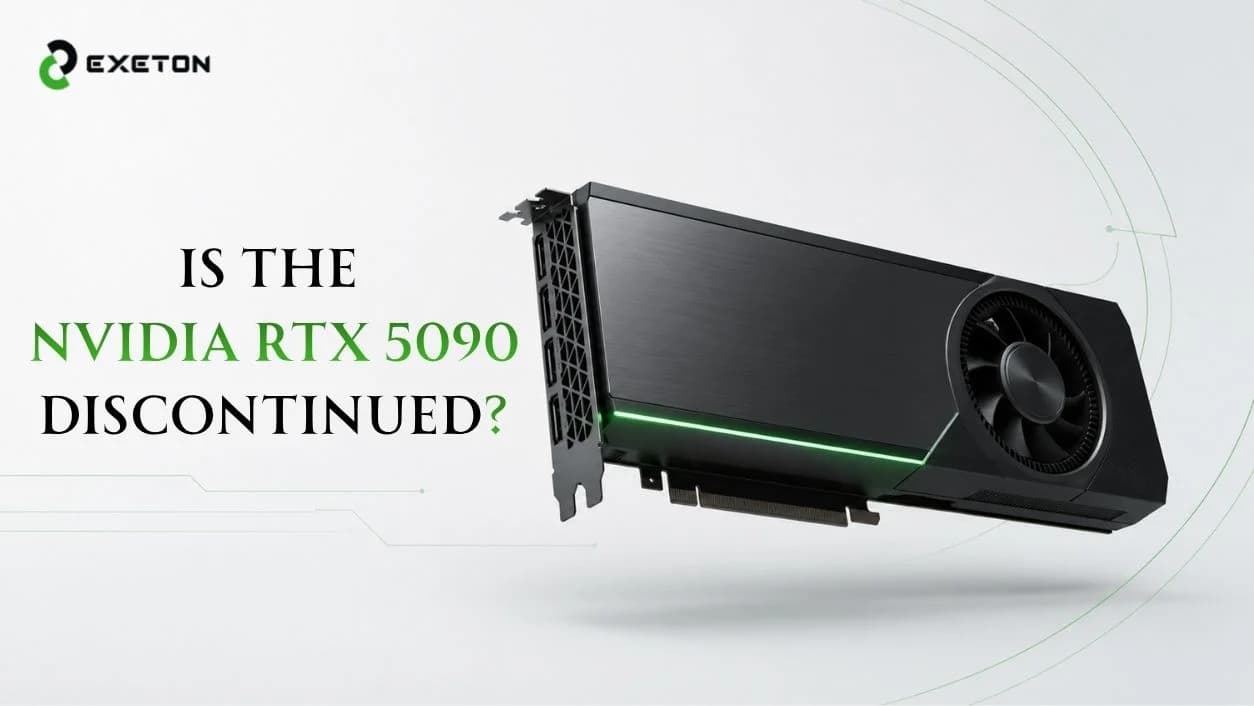
Is the Nvidia RTX 5090 Discontinued? Supply Status and What It Means for AI Infrastructure Buyers
Article Summary:
NVIDIA's RTX 5090 is reportedly still shipping, but supply remains constrained. NVIDIA has not officially confirmed the executive's reported statement on the record.
The card is absent from NVIDIA's online store and Micro Center, while third-party listings show reported prices of around $8,500 and $7,300, respectively, as of October 2026.
Businesses planning AI or high-performance computing (HPC) projects should assess confirmed availability, workload requirements, and alternatives rather than relying on consumer retail listings alone.
Can you still buy one of the most powerful consumer graphics cards in 2026, or has it quietly disappeared from the market?
The NVIDIA GeForce RTX 5090 has become difficult to find through major retail channels, and reports of a possible production halt have raised questions about its future. For AI developers, researchers, and businesses planning computing upgrades, the uncertainty creates a practical challenge: should they wait for stock to return or consider another GPU?
Exeton helps businesses evaluate computing hardware against their performance, deployment, and infrastructure requirements. Understanding the RTX 5090's reported supply position is a useful first step toward making that decision.
Is the RTX 5090 discontinued?
No confirmed discontinuation has been announced, but the RTX 5090 remains difficult to find. According to reports published by Tom's Hardware on October 17, 2026, a senior NVIDIA executive reportedly said the card had not been discontinued and would continue shipping despite constrained supply. NVIDIA has not confirmed that statement on the record.
Discontinued means a manufacturer has stopped making or supplying a product as an active offering. Limited availability does not automatically mean production has ended.
The uncertainty stems from several developments:
The RTX 5090 has disappeared from NVIDIA's online store and Micro Center's active listings.
Rumors of a production halt emerged after reports that the RTX 50 Super series had been put on hold.
Reports suggest manufacturing capacity may be under pressure, but the available information does not establish that RTX 5090 production has permanently ended.
For anyone asking, "Can you still buy an RTX 5090 in 2026?", the answer is yes, potentially through third-party sellers. However, finding a listing does not guarantee that the product is in stock, genuine, or available on acceptable terms.
Where can you buy an RTX 5090 right now?
The RTX 5090 is reportedly available through some third-party marketplace listings, but major retail availability is limited. The reported prices below reflect listings observed as of October 2026, not verified offers or guaranteed transaction prices.
Exeton's NVIDIA GeForce RTX 5090 Founders Edition page is another place to check for product information. Confirm current availability and commercial terms directly before making a purchasing decision.
If a listing looks unusually expensive or offers immediate delivery despite widespread shortages, verify the seller's identity, the exact card model, warranty coverage, and return conditions before paying.
Why are RTX 5090 prices so high?
RTX 5090 prices are elevated because limited supply leaves buyers competing for the relatively few cards listed for sale. Third-party marketplace pricing can rise sharply when normal retail channels have little or no stock.
Several factors help explain why the RTX 5090 is so expensive:
Constrained supply:
Fewer available cards mean sellers face less pressure to compete on price.
Third-party markups:
Marketplace sellers can set prices well above a product's original retail price.
Import tariffs and shipping:
Depending on the destination and seller, tariffs, taxes, and international delivery costs may increase the final bill.
Uncertainty about future supply:
Rumors of a production halt can encourage buyers to purchase sooner, adding pressure to an already limited market.
The final cost depends on the seller, shipping arrangements, and applicable import charges.
For organizations purchasing multiple GPUs, evaluating total project cost is more useful than focusing on a single marketplace price.
What does this mean for AI and HPC buyers?
For AI and high-performance computing (HPC) buyers, the shortage is a reason to plan around verified supply rather than assume a retail GPU will be available when needed. HPC means using powerful computing systems to handle demanding workloads such as scientific simulations, engineering calculations, and AI model development.
The RTX 5090 is a consumer graphics card that can support certain local AI workloads, including running AI models and experimenting with machine learning. However, its availability and suitability should be evaluated separately from those of enterprise GPU systems designed for larger or more demanding deployments.
Businesses should consider three questions before committing to a GPU purchase:
Does the workload require this specific GPU? Match graphics memory, processing requirements, software compatibility, and performance expectations to the intended application.
Can the project tolerate uncertain supply? Confirm stock, pricing, warranty coverage, and delivery arrangements before setting deployment dates.
Would another configuration meet the same objective? Compare alternatives based on actual workload requirements instead of selecting hardware solely because it is the current flagship.
For professionals who need a capable GPU for local AI development or other graphics-intensive workloads, the PNY GeForce RTX 5080 16GB is an alternative worth evaluating. Its 16GB of graphics memory may suit some smaller AI models and development tasks, but it is not a universal replacement for the RTX 5090. Model size, quantization, context length, and workload complexity affect what can run successfully.
Exeton can help businesses assess GPU options against their intended applications and infrastructure requirements. For larger AI deployments, the best GPU for an AI data center alternative may be a different class of hardware entirely. The right choice depends on scale, memory requirements, software, power, cooling, and budget.
Frequently asked questions
Is the RTX 5090 still being made in 2026?
According to reports published on October 17, 2026, a senior NVIDIA executive reportedly said the RTX 5090 had not been discontinued and would continue shipping despite constrained supply. NVIDIA has not confirmed the statement on the record, so its current production status remains officially unconfirmed.
Why is the RTX 5090 so expensive right now?
Limited availability, third-party seller markups, and uncertainty about future supply are contributing to elevated asking prices.
Which GPU should a business consider if the RTX 5090 is out of stock?
The PNY GeForce RTX 5080 16GB is one option to evaluate for compatible AI development and graphics workloads. Businesses with larger models, demanding memory requirements, or multi-GPU needs should compare other workstation and enterprise GPU configurations before choosing a replacement.
Conclusion
The NVIDIA RTX 5090 has not been confirmed as discontinued, but constrained supply and unusually high marketplace prices make purchasing decisions more difficult as of October 2026. The reported executive statement offers some reassurance, yet it does not guarantee availability, pricing stability, or a delivery date.
For businesses and professionals, the sensible next step is to match hardware to the workload, verify supply, and compare viable alternatives before committing to a project.
Exeton helps organizations evaluate computing hardware and AI infrastructure options for their requirements. If you are planning an AI deployment or looking for a suitable GPU configuration, contact our sales team to discuss your requirements and available options.