



How International Telecom Giants Are Reinventing Themselves as Cloud & AI Powerhouses: Beyond Connectivity
PublishedOver 70% of global telecommunications operators are making that exact pivot, transforming their physical real estate and connectivity grids into full-blown AI cloud factories.
Around the world, from regional heavyweights like du and e& in the Middle East, to digital powerhouses like Reliance Jio and Bharti Airtel in India, alongside Deutsche Telekom and Vodafone in Europe, Singtel in Asia, and AT&T in North America, the telecom landscape is undergoing an irreversible shift. Pure connectivity and standard mobile data plans are no longer high-margin growth drivers. To unlock new revenue, international telecom leaders are investing billions in enterprise AI infrastructure, sovereign data storage, and low-latency cloud computing.
However, transitioning from a traditional network provider to a high-demand AI cloud host presents a severe physical bottleneck: handling massive compute density, extreme server heat, and complex hardware integration.
This is where specialized server architecture, high-performance GPU systems, and custom data center cooling solutions become critical to powering this global pivot.
How Are Telecoms Managing AI Workflows and Cloud Orchestration?
International telecoms are building managed cloud platforms so local enterprises and government bodies can run complex AI applications locally without sending sensitive data across international borders.
Workflow Management & AI Orchestration
Software & Management Layer: Modern telecom clouds use centralized management dashboards to assign computing workloads, launch virtual servers, and monitor system health in real time.
Telemetry & Observability: Real-time tracking tools log data processing speeds, track graphics processing unit (GPU) memory consumption, and flag system health issues to prevent service downtime.
Why Is Hardware Configuration Critical for Telecom AI Infrastructure?
Running enterprise artificial intelligence requires specialized hardware that draws massive electrical power and generates intense heat. Standard server cabinets simply melt down under these heavy processing tasks without updated physical infrastructure.
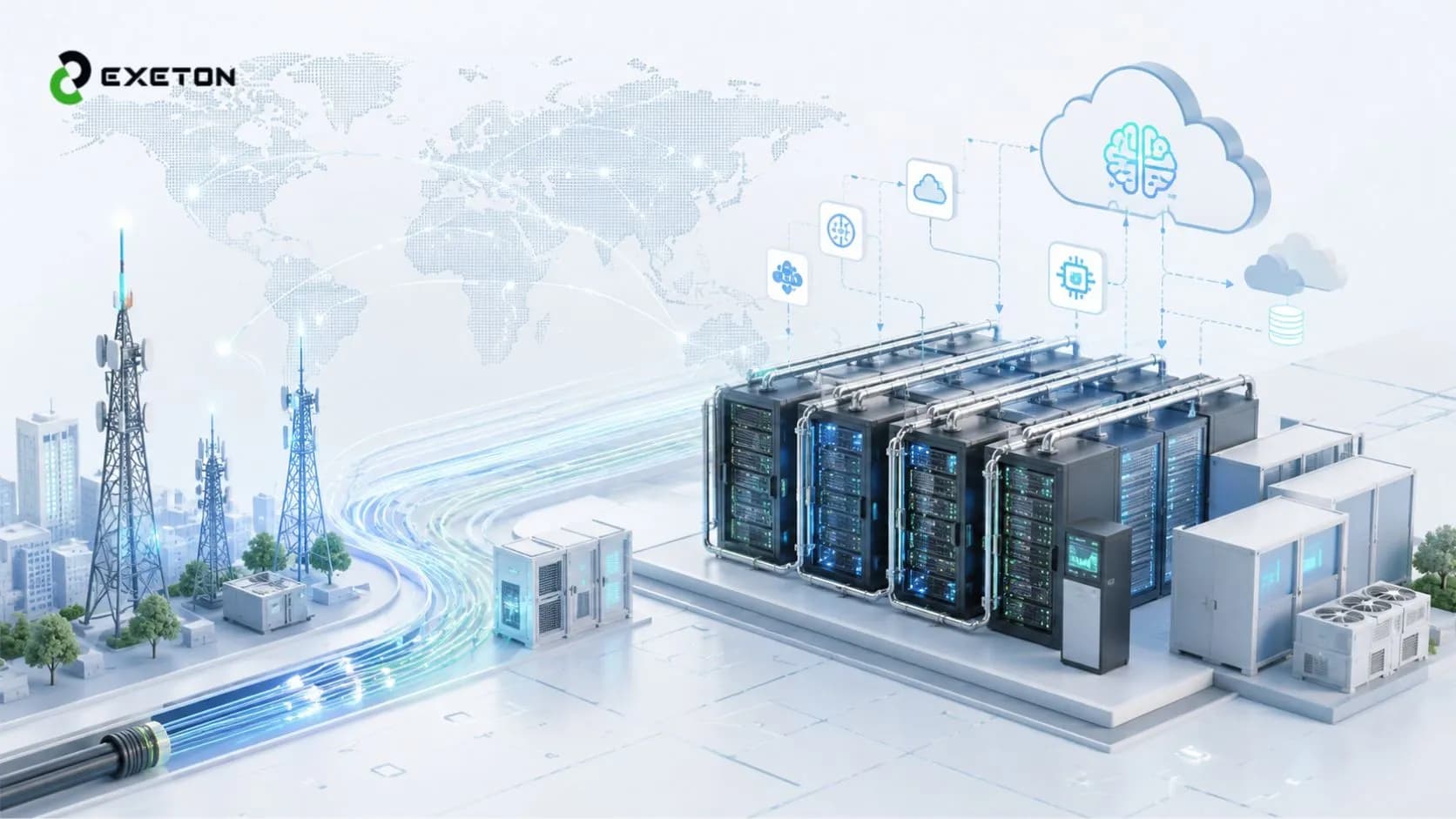
The Telecom-to-AI Value Chain:
Global Telecom Operator Network -> High-Density Exeton GPU Servers & Liquid Cooling Loops -> Turnkey Sovereign AI & Managed Cloud Services
Infrastructure, Hardware, & Server Configurations
Thermal & Power Efficiency: High-performance AI processing units emit extreme heat. Exeton designs optimized server rack layouts, dynamic airflow enclosures, and liquid cooling systems that keep hardware cool while reducing total electricity consumption.
Compute Architecture: These setups combine enterprise storage arrays, high-speed memory modules, and specialized GPU clusters capable of handling heavy machine learning tasks without performance bottlenecks.
What Role Does Security Play in Telecom Cloud Deployments?
Data sovereignty, the legal requirement that corporate and citizen data must stay stored within national borders is now strictly enforced by governments worldwide.
Zero-Trust Security & Deployment Environments
Network Automation: Automated network rules continuously check system integrity, isolating compromised network paths if unusual configuration changes occur.
Air-Gapped & Sovereign Clouds: Exeton provides standardized hardware builds designed for completely isolated ("air-gapped") environments, guaranteeing that confidential corporate and public data remains fully protected from external leaks.
How Does Telecom AI Infrastructure Compare Across Global Markets?
Region / Market | Primary Telecom Focus | Key Infrastructure Need | How Exeton Delivers |
Middle East (UAE / KSA) | Sovereign Cloud & AI Data Centers | High-density GPU integration & extreme cooling | Liquid-cooled server rack builds suited for high ambient heat |
Europe (EU) | Strict Data Privacy & Regulatory Compliance | Air-gapped security & high-efficiency power usage | Zero-trust, energy-compliant hardware architecture |
North America | Edge Computing & Low Latency | Scalable cluster setups & rapid hardware deployment | Pre-configured, turnkey GPU server assemblies |
Asia-Pacific (APAC) | Managed Business AI & Enterprise SaaS | Multi-vendor component support & flexible scaling | Modular server architecture for rapid capacity expansion |
Strategic Collaborations & Hardware Procurement
To build out these enterprise cloud offerings, global operators, whether du expanding local AI capabilities, Orange delivering sovereign cloud tools across Europe, or Airtel upgrading regional infrastructure, require proven hardware providers. Exeton collaborates directly with tech leaders to build deployment-ready, highly reliable server setups tailored for large-scale enterprise purchasing.
Commercial Value & Scalability
By procuring pre-tested, integrated server hardware from Exeton, telecom firms skip months of trial-and-error hardware engineering. This lets them bring enterprise cloud services to market faster, generating immediate new revenue streams.
Conclusion
The global telecommunications industry's pivot toward managed AI and cloud computing is reshaping how enterprises process and protect their data. By delivering high-density GPU server integrations, specialized liquid cooling, and sovereign cloud hardware setups, Exeton provides the underlying infrastructure powering this digital evolution.
Frequently Asked Questions (FAQ)
1. What is a sovereign cloud in telecommunications?
A sovereign cloud is an isolated computing environment where all physical servers, data storage, and network operations stay strictly inside a country's borders, governed entirely by local data privacy laws.
2. Why do telecom operators need specialized GPU server infrastructure for AI?
Standard central processing units (CPUs) cannot handle the heavy mathematical calculations required by modern AI. High-density GPU server setups engineered by Exeton deliver the parallel processing power required to run AI workloads reliably.
3. How can international telecom companies purchase server infrastructure from Exeton?
Global telecom procurement teams can source custom server systems directly through Exeton's enterprise division, which handles system architecture, thermal cooling integration, and deployment support.