




How Anthropic AI Benefits From Modern Deep Learning Infrastructure
Generative AI companies are growing at an incredible pace. From intelligent chatbots to advanced coding assistants, modern AI systems now process billions of parameters and massive amounts of data every day.
Companies like Anthropic are helping drive this transformation by developing advanced large language models designed to perform complex reasoning and natural conversations. But behind every powerful AI model is something even more important: deep learning infrastructure.
Without modern AI infrastructure, even the most advanced AI models would struggle to train, scale, or deliver reliable responses to users.
For CTOs, AI engineers, and enterprise leaders, understanding how deep learning infrastructure works is becoming essential. It is no longer just a backend IT topic, it is the foundation of competitive AI innovation.
What Is Deep Learning Infrastructure?
Deep learning infrastructure refers to the hardware, networking, storage, and software systems required to train and run modern AI models.
Think of it as the “industrial foundation” behind artificial intelligence.
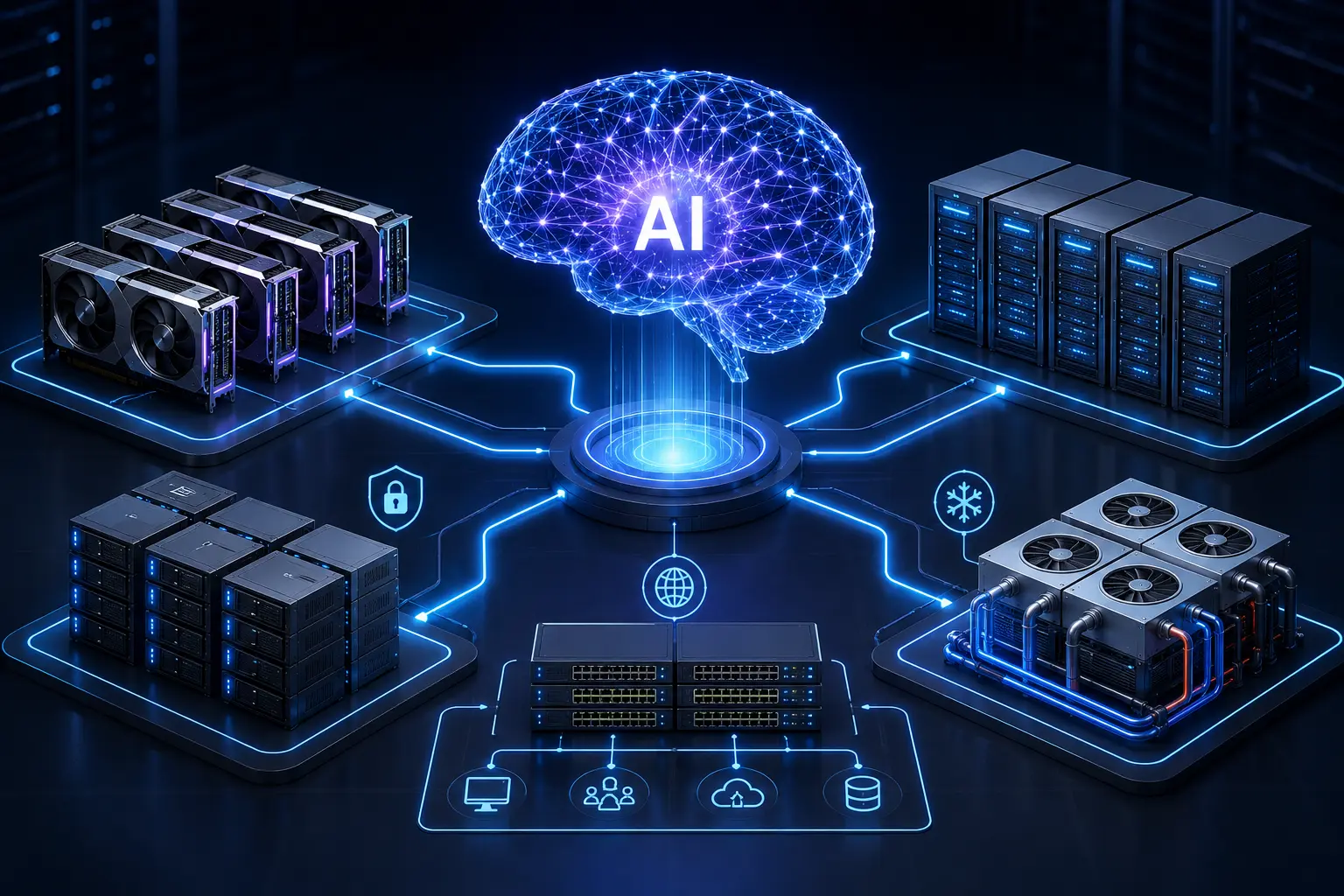
If an AI model is the brain, the infrastructure is everything that keeps the brain functioning:
GPUs provide computational power
AI servers coordinate workloads
Networking moves data between systems
Storage platforms feed training datasets
Cooling and power systems keep everything stable
Modern AI companies depend on highly optimized AI compute infrastructure because training large models requires enormous processing capability.
Why Is Deep Learning Infrastructure So Important?
Large AI models can contain billions or even trillions of parameters. Training them involves processing huge datasets repeatedly across thousands of GPU cores.
Without scalable infrastructure:
Training becomes too slow
Costs increase dramatically
Inference performance suffers
System reliability decreases
This is why advanced enterprise AI systems are designed around performance, scalability, and uptime.
Why Does Anthropic Need Advanced AI Infrastructure?
Modern AI companies operate at a scale far beyond traditional software businesses.
Training a large language model is similar to building a massive digital factory. Every component must work together continuously and efficiently.
Key Infrastructure Needs for AI Companies
Massive Compute Power
Training modern AI models requires thousands of GPUs working simultaneously.
These GPUs process mathematical operations in parallel, dramatically accelerating deep learning tasks compared to traditional CPUs.
Continuous Data Movement
AI training datasets are enormous. High-speed networking is critical for moving data between GPU clusters without delays.
Even small bottlenecks can slow down training significantly.
Reliable Inference Systems
After training, AI models must respond quickly to user requests.
Low-latency infrastructure ensures users receive fast, accurate outputs, whether they are asking questions, generating code, or analyzing documents.
How Do GPU Clusters Support Large AI Models?
GPU clusters are one of the most important components of modern deep learning infrastructure.
What Is a GPU Cluster?
A GPU cluster is a group of interconnected graphics processing units working together as a unified compute system.
Instead of relying on a single machine, AI workloads are distributed across many GPUs.
Simple Analogy
Imagine trying to move an entire library by yourself.
It would take weeks.
Now imagine 1,000 people moving books together simultaneously. The process becomes dramatically faster.
That is essentially how GPU clusters accelerate large language model training.
Benefits of GPU Clusters
Faster Training
Parallel processing allows AI models to train in days or weeks instead of months.
Better Scalability
Infrastructure can expand as AI workloads grow.
Higher Reliability
Distributed systems reduce the risk of single points of failure.
Efficient Resource Allocation
AI teams can dynamically allocate compute resources based on workload demands.
What Infrastructure Is Required for Modern AI Companies?
Modern AI systems rely on multiple infrastructure layers working together seamlessly.
GPUs and AI Servers
GPUs are the computational engine behind AI training and inference.
AI servers house these GPUs and provide:
High memory bandwidth
Multi-GPU coordination
Optimized AI workloads
Enterprise reliability
Modern AI infrastructure often includes rack-scale GPU deployments designed specifically for machine learning operations.
High-Speed Networking
AI workloads require constant communication between servers and GPUs.
Low-latency networking technologies help:
Synchronize distributed training
Reduce communication delays
Improve training efficiency
Support real-time inference
Without fast networking, even powerful GPUs can become underutilized.
Data Storage Systems
AI models rely on massive datasets.
Storage infrastructure must deliver:
High throughput
Fast data access
Reliable redundancy
Scalable capacity
For modern AI companies, storage performance directly impacts model training speed.
Cooling and Power Systems
AI infrastructure consumes enormous amounts of electricity.
High-density GPU environments generate significant heat, making advanced cooling systems essential.
Modern data centers increasingly rely on:
Liquid cooling
Precision airflow management
Redundant power systems
Energy-efficient infrastructure design
Cooling is no longer just a facilities concern, it is now a core AI scalability requirement.
How Scalable AI Infrastructure Benefits Companies Like Anthropic
Scalable infrastructure enables AI organizations to innovate faster while maintaining operational reliability.
Faster Innovation Cycles
More compute power allows teams to:
Train larger models
Experiment more frequently
Reduce development timelines
Accelerate research iterations
This creates a major competitive advantage in the fast-moving AI industry.
Lower Latency AI Responses
Inference infrastructure determines how quickly users receive outputs.
Efficient AI compute infrastructure improves:
User experience
API responsiveness
Real-time AI applications
Enterprise deployment performance
Improved Reliability and Uptime
Enterprise AI applications require continuous availability.
Infrastructure resilience helps ensure:
Stable performance
Redundant failover systems
Reduced downtime
Consistent service delivery
For AI companies serving global users, uptime is critical.
What Challenges Do Modern AI Infrastructure Providers Face?
Building AI infrastructure at scale introduces several operational challenges.
Power Density
GPU clusters consume significantly more power than traditional servers.
This increases demands on:
Electrical systems
Rack design
Facility engineering
Energy efficiency planning
Cooling Complexity
As GPU density rises, cooling becomes increasingly difficult.
Traditional air cooling may struggle to handle modern AI workloads efficiently.
This is why advanced cooling strategies are becoming standard in enterprise AI environments.
GPU Availability
Global demand for AI GPUs continues to grow rapidly.
Organizations often face challenges involving:
Hardware procurement
Capacity planning
Deployment timelines
Cost management
Infrastructure Scaling
AI workloads evolve quickly.
Infrastructure must scale without causing operational disruption or performance bottlenecks.
Flexible, modular infrastructure design is becoming essential for long-term AI growth.
How EXETON Supports Enterprise AI Infrastructure
As organizations expand their AI initiatives, infrastructure decisions become increasingly strategic.
Exeton Computer Network & Infrastructure Installation & Maintenance L.L.C S.O.C helps enterprises build scalable AI environments through solutions designed for modern deep learning workloads, including:
GPU infrastructure deployments
Enterprise AI servers
High-performance data center solutions
Scalable AI compute environments
SLA-backed infrastructure support
For businesses deploying advanced AI applications, infrastructure reliability and scalability can directly influence operational success.
FAQ
What is deep learning infrastructure?
Deep learning infrastructure includes the hardware and systems required to train and run AI models, such as GPUs, servers, networking, storage, and cooling systems.
Why are GPU clusters important for AI?
GPU clusters allow AI workloads to run in parallel, dramatically improving training speed, scalability, and performance for large AI models.
What challenges do AI companies face with infrastructure?
Common challenges include power consumption, cooling requirements, GPU availability, infrastructure scaling, and maintaining reliable uptime.
How does AI infrastructure improve large language model training?
Modern AI infrastructure enables faster data processing, distributed computing, and efficient resource utilization, helping reduce training times significantly.
Why do enterprise AI systems require specialized infrastructure?
Enterprise AI systems must handle large workloads reliably while delivering fast response times, scalability, and high availability.
Explore Scalable AI Infrastructure With EXETON
As AI adoption accelerates, organizations need infrastructure designed specifically for modern deep learning workloads.
Exeton Computer Network & Infrastructure Installation & Maintenance L.L.C S.O.C delivers enterprise-grade AI infrastructure solutions that help businesses scale AI operations with performance, reliability, and long-term flexibility in mind.