



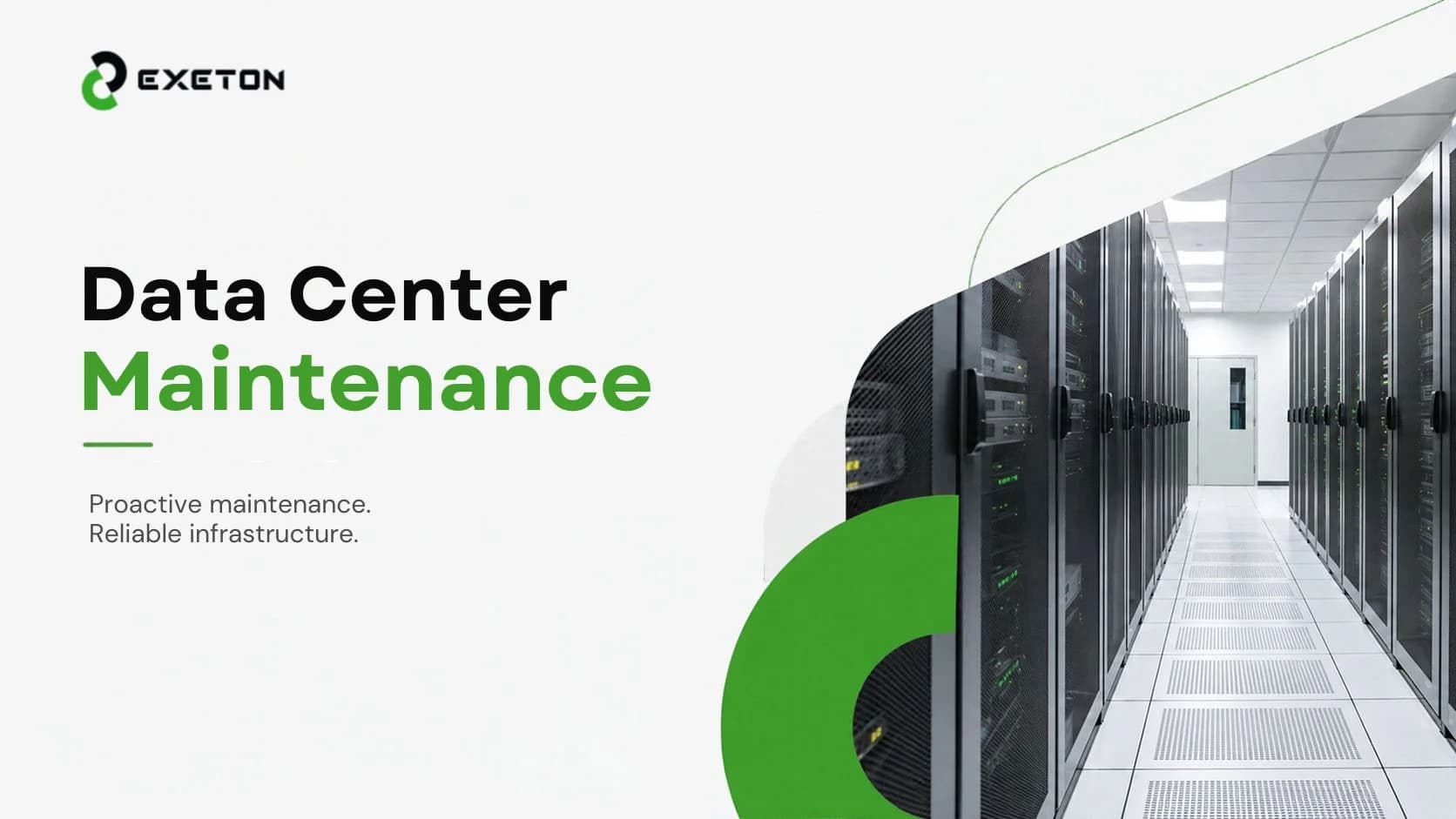
Data Center Maintenance in UAE: Essential Services, Best Practices, and How to Choose the Right Provider
Article Summary
Regular data center maintenance helps reduce avoidable failures, protect critical infrastructure, and support business continuity.
Power, cooling, IT equipment, and monitoring systems require coordinated maintenance based on operational needs.
Choosing the right provider involves evaluating technical expertise, preventive maintenance processes, support agreements, and long-term infrastructure requirements.
How Much Can One Small Infrastructure Failure Cost Your Business?
A server stops responding. Temperatures begin to rise. A backup power system fails when it is needed most. What starts as a small technical issue can quickly become an operational headache, affecting employees, customers, and business-critical applications.
For organizations operating data centers, reliability rarely happens by accident. It comes from consistent monitoring, careful planning, and maintenance that identifies potential problems before they escalate.
As businesses in the UAE and around the world depend increasingly on digital infrastructure, data center maintenance has become an important part of managing operational risk. Exeton supports organizations with data center infrastructure solutions, including managed operations and preventive maintenance.
But what does effective maintenance actually involve, and how can businesses choose the right support?
What Is Data Center Maintenance, and Why Does It Matter?
Data center maintenance is the planned inspection, testing, servicing, and repair of the equipment and systems that keep computing infrastructure operational.
It generally includes three approaches:
Preventive maintenance:
Scheduled inspections and servicing designed to reduce the likelihood of equipment failure.
Predictive maintenance:
Using monitoring data and performance trends to identify warning signs before a fault occurs.
Corrective maintenance:
Diagnosing and repairing equipment after a problem has developed.
A good maintenance plan combines these approaches according to the facility's needs. It can help reduce unexpected interruptions, maintain equipment performance, and give technical teams greater visibility into infrastructure risks.
Which Data Center Systems Need Regular Maintenance?
A data center is more than a room filled with servers. Its supporting systems must work together to keep workloads running reliably.
Power infrastructure:
UPS units, batteries, power distribution equipment, and backup generators should be inspected and tested according to manufacturer guidance and site procedures.
Cooling systems:
Airflow, filters, temperature sensors, and cooling equipment need attention to help prevent overheating and unnecessary energy consumption.
Servers and networking:
Hardware health, firmware, cabling, storage, and network connectivity require appropriate checks and planned updates.
Monitoring and safety systems:
Environmental sensors, alarms, access controls, and incident procedures should be reviewed to ensure that potential issues are identified and handled appropriately.
Neglecting one area can affect the others. For example, restricted airflow can increase equipment temperatures, while a poorly maintained UPS battery can compromise power protection.
How Often Should Data Center Maintenance Be Performed?
There is no single maintenance schedule suitable for every facility. Frequency depends on equipment specifications, operating conditions, workload criticality, redundancy, and manufacturer recommendations.
Maintenance activity | Typical approach | Main purpose |
Infrastructure monitoring | Continuous, where supported | Identify abnormal conditions |
Visual inspections and alarm reviews | At planned intervals | Detect emerging issues |
Equipment servicing and testing | According to manufacturer guidance and risk | Maintain operational readiness |
Infrastructure and capacity reviews | Periodically and after significant changes | Plan upgrades and manage risks |
Businesses should document maintenance activities, review recurring faults, and establish clear escalation procedures.
For organizations planning, upgrading, or managing their infrastructure,
Exeton provides an entry point to explore its computing and infrastructure offerings.
How Can You Choose the Right Data Center Maintenance Provider?
The right provider should understand your environment, the consequences of downtime, and the level of support your organization actually needs.
Before making a decision, consider these questions:
Does the provider have relevant technical expertise? Look for experience with the equipment and infrastructure in your environment.
Are maintenance responsibilities clearly defined? Understand which systems, inspections, repairs, and reporting activities are included.
What does the service-level agreement cover? Review response targets, support hours, escalation routes, and any resolution commitments.
Can the provider support future growth? Consider upgrades, capacity planning, and ongoing lifecycle support.
Are procedures and documentation maintained? Asset records, maintenance logs, change approvals, and recovery plans help teams work consistently.
For organizations purchasing advanced computing hardware, documentation may also extend to applicable export-control requirements. Exeton provides
compliance forms for relevant advanced-computing transactions; these are distinct from routine facility maintenance records.
Compare providers against your actual operational requirements rather than relying solely on broad claims about reliability or service quality.
How Does Proactive Maintenance Support Long-Term Performance?
Maintenance should not stop at fixing immediate faults. Reviewing recurring incidents, equipment health, energy use, and available capacity can help organizations decide when to repair, replace, or upgrade infrastructure.
For example, repeated cooling alerts may indicate that airflow needs attention or that a capacity upgrade deserves consideration. Similarly, recurring hardware faults may point to an underlying issue that replacing individual components will not resolve.
Exeton's data center solutions cover infrastructure design and build, modernization, managed operations, preventive maintenance, and capacity planning. These services are relevant to organizations assessing their infrastructure requirements throughout its lifecycle.
The important principle is to treat maintenance as an ongoing operational process, not simply a response to equipment failure.
Is Your Data Center Ready for the Next Challenge?
Reliable infrastructure depends on more than powerful servers. It requires dependable power, effective cooling, consistent monitoring, documented procedures, and a maintenance plan suited to the business.
Whether managing an existing facility or preparing for future growth, organizations should evaluate their infrastructure risks and establish clear maintenance priorities before problems arise.
Exeton can be a starting point for businesses exploring data center infrastructure and managed operations. The next step is to review your current environment, identify potential gaps, and determine what level of maintenance and support best fits your operational needs.
Frequently Asked Questions
1. What is included in data center maintenance?
It can include power and cooling inspections, server and network checks, monitoring, firmware updates, equipment testing, and incident response.
2. Does data center maintenance require downtime?
Not necessarily. Many tasks can be planned around redundant systems and approved maintenance windows, although some work may require temporary service interruptions.
3. What should businesses look for in a maintenance contract?
Review the scope of work, preventive maintenance schedule, response times, support coverage, reporting requirements, exclusions, and escalation procedures