



Cloud vs. On-Prem TCO: How to Eliminate "API Bill Shock" for Enterprise LLMs
PublishedWhat is the most expensive part of a cheap office printer? It isn’t the machine, it’s the ink.
Enterprise cloud AI has adopted that exact same business model.
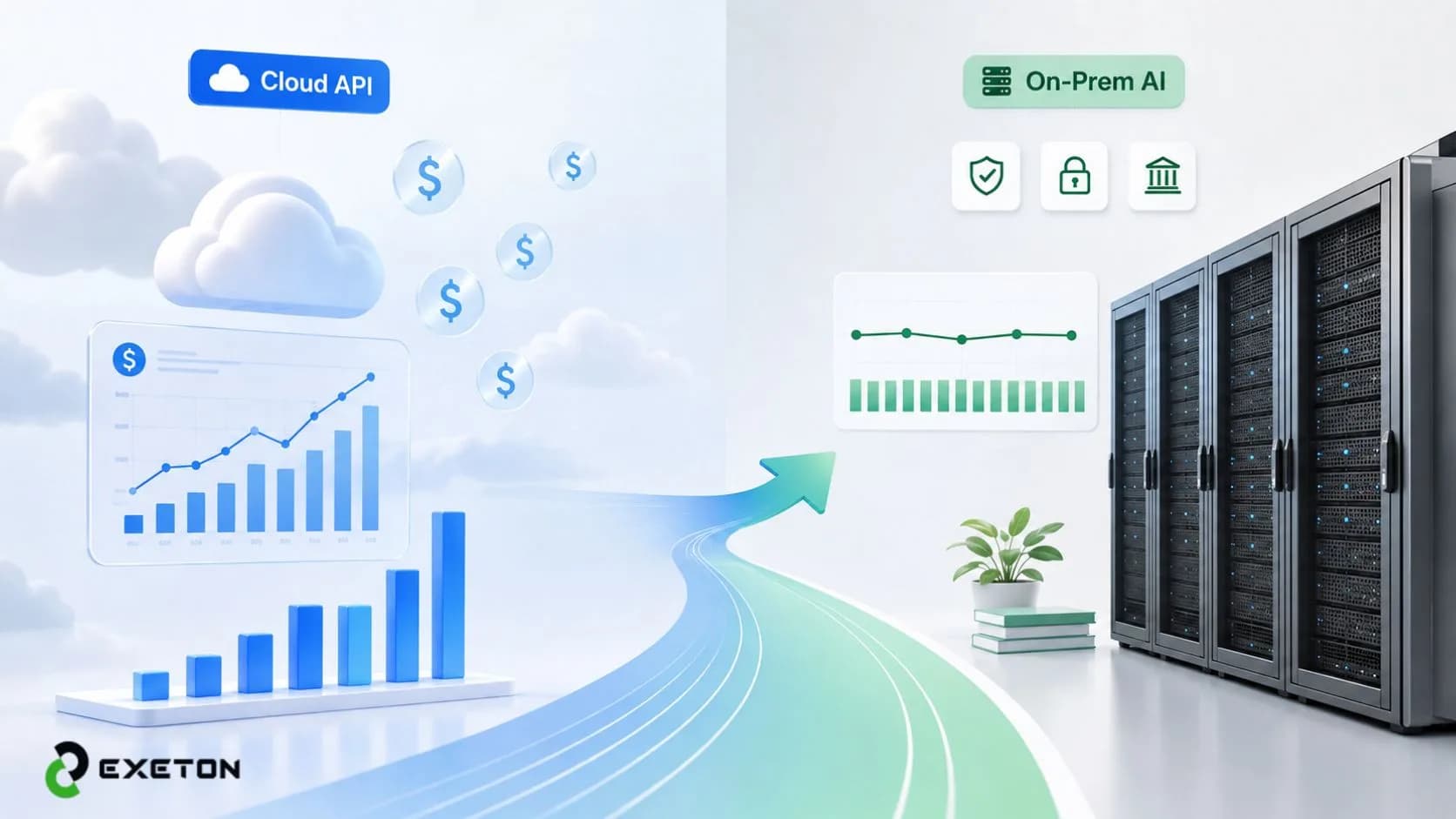
When companies first try out Large Language Models (LLMs), paying a public cloud provider a fraction of a cent per request feels cheap and effortless. But as those AI tools expand to thousands of employees and customers running 24/7, those tiny charges compound into massive monthly bills. This scenario, known as "API bill shock," is forcing business leaders to rethink their entire AI strategy.
As organizations move from testing to full production, switching from cloud APIs to dedicated on-premises (on-prem) hardware is no longer just a financial calculation, it is a core business move. Industry leaders like Exeton help companies design, deploy, and maintain custom server infrastructure that turns unpredictable cloud costs into stable, long-term assets.
Why Are Cloud API Fees Causing Severe "API Bill Shock"?
Cloud API fees cause bill shock because providers charge for every single word processed, meaning your costs rise infinitely as your usage grows.
When a company relies entirely on third-party cloud APIs, its monthly bill is tied directly to user activity. Modern AI applications, like internal document search tools or automated customer service agents, do not just answer single questions. They process thousands of background tokens checking records, verifying context, and formatting replies.
This setup creates three main operational headaches:
Unpredictable Monthly Expenses: Financial teams cannot accurately forecast annual budgets when monthly AI costs swing wildly based on usage.
The Success Penalty: The more your employees use and love your AI tools, the higher your monthly cloud fine becomes.
Data Inflation: Complex enterprise tasks require sending huge amounts of background context over the internet, multiplying the fees charged by cloud vendors.
How Does On-Premises Hardware Fix AI Cost Predictability?
On-premises hardware fixes cost predictability by replacing variable per-query fees with a fixed, one-time equipment investment that keeps monthly operating costs flat regardless of usage volume.
Switching to an on-premises setup means purchasing and owning dedicated multi-GPU server racks in your own building or a local colocation facility. While buying physical hardware requires an upfront investment, the economic model changes completely once it is running.
Processing ten million requests a day on your own server costs roughly the same as processing ten, your main ongoing costs are just basic power, cooling, and maintenance. For organizations running heavy, continuous AI workloads, owning the hardware typically pays for itself within six to twelve months, unlocking huge savings over a standard three-to-five-year server life cycle.
Feature | Public Cloud APIs | Dedicated On-Premises Racks |
Cost Structure | Variable (Pay for every request) | Fixed upfront + predictable power/cooling |
Financial Impact of Growth | Bills scale up continuously with usage | Costs stay flat regardless of volume |
Data Privacy | Sensitive data travels over external networks | 100% internal and air-gapped security |
Hardware Control | Shared, generic cloud resources | Tailored multi-GPU setups built for your exact needs |
Average Payback Period | Ongoing continuous fee | Full return on investment (ROI) in 6 to 12 months |
Building an efficient local computing footprint requires choosing hardware that matches your workload without overspending. Infrastructure specialists like Exeton provide enterprises with tailored GPU server configurations, high-density storage, and deep learning setups engineered to maximize performance while locking in predictable costs.
Is On-Premises AI Hardware Secure Enough for Regulated Sectors?
Yes, on-premises AI hardware provides top-tier security because your data stays strictly inside your physical network, eliminating the risk of leaking confidential information to third-party models.
Beyond saving money, data privacy and legal compliance drive the shift toward local hardware. Regulated fields, such as banking, healthcare, legal, and government, face strict laws (like HIPAA or GDPR) that make sending confidential files over external cloud APIs risky or prohibited.
By running open-weight AI models on local server racks, organizations maintain full control over their sensitive information:
Complete Data Protection: Proprietary source code, customer files, and financial records never leave your secure internal network.
Zero Training Exposure: Local hosting ensures your business data is never logged or used by external cloud companies to train public models.
Total Access Control: Your internal security team retains full visibility over who accesses data and how encryption is handled.
Frequently Asked Questions (FAQ)
What is the difference between open-weight models and closed cloud APIs?
Closed cloud APIs require sending your data to a third party's remote servers to use their models. Open-weight models (like Llama 3 or Mistral) allow you to download the model and run it directly on your own hardware with total privacy.
When does it make financial sense to switch to on-premises GPUs?
Making the switch makes sense when your monthly cloud API bills reach a steady baseline (typically $5,000 to $10,000+ per month) or when your internal AI tools run continuously throughout the day.
Do local open-weight models perform as well as top-tier cloud APIs?
Yes. Modern open-weight models perform exceptionally well for over 80% of daily business tasks, including document processing, customer support automation, data extraction, and internal coding help.
Taking Control of Your Enterprise AI Infrastructure
The era of blindly paying per-query cloud fees for AI is ending. While public cloud APIs are great for early testing, relying on them for heavy production creates severe financial instability and privacy risks.
By transitioning to dedicated server hardware, modern businesses eliminate API bill shock, protect their proprietary data, and establish a predictable budget for years to come. Whether your team needs high-density GPU servers, storage optimization, or specialized hardware support, Exeton delivers the expertise required to build a secure, cost-effective, and future-proof AI foundation.