



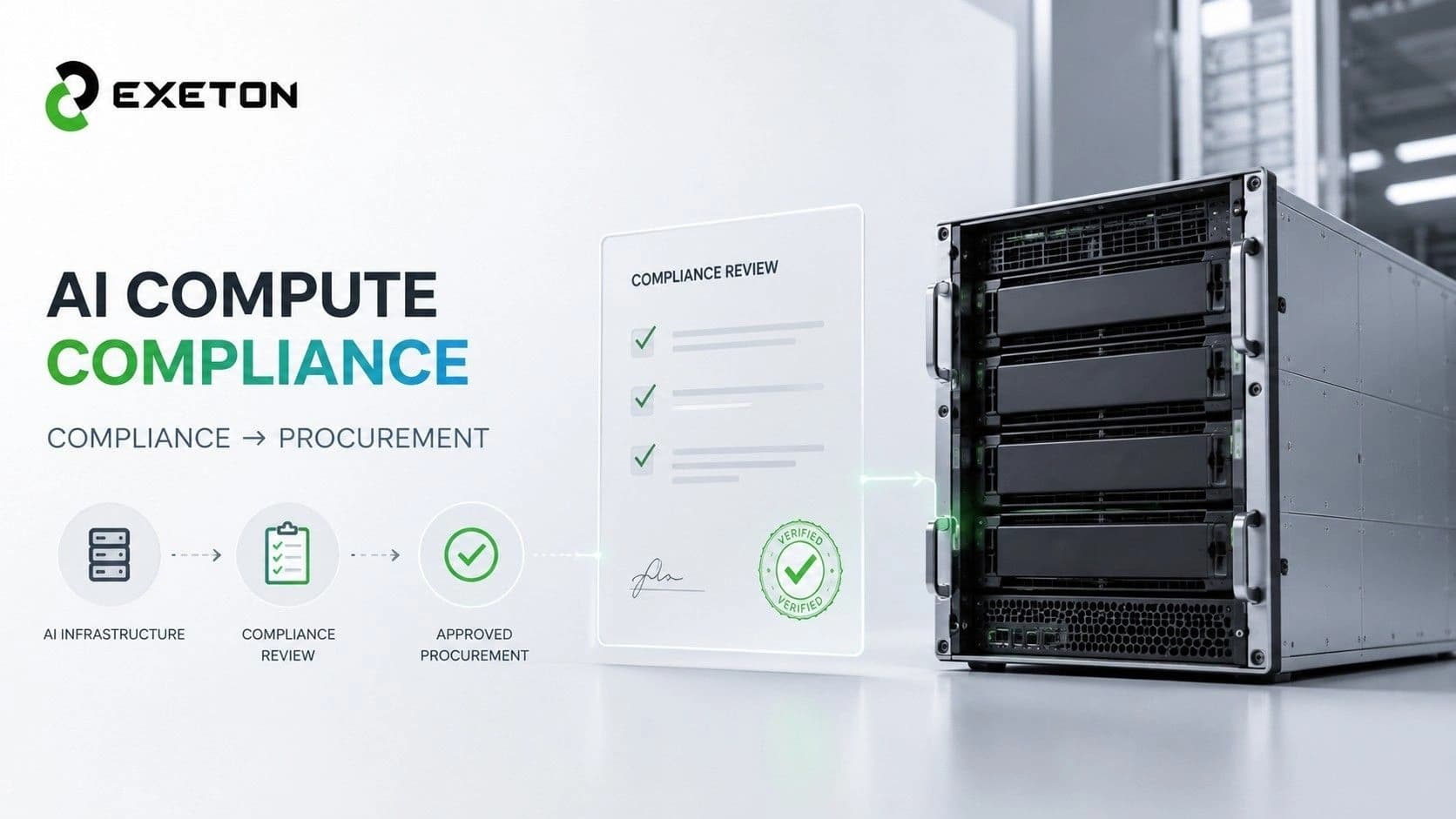
AI Compute Compliance in 2026: Why Compliance Comes Before Your GPU Quote
Article Summary
AI hardware procurement increasingly requires compliance review before pricing, availability, and lead times can be confirmed.
Manufacturers may need details about the end user, deployment location, intended use, and project scale.
Completing compliance documentation early can help reduce procurement and delivery delays.
The fastest way to delay an AI infrastructure project isn't always a GPU shortage. Sometimes, it's skipping compliance until the last minute.
As demand for AI infrastructure continues to grow, enterprise GPU and AI server procurement has changed. Many organizations expect to request a quotation first and address compliance afterward. For certain advanced AI hardware, that sequence may be reversed.
Before requesting a formal quotation, review and complete the applicable AI Infrastructure Compliance Documents.
[Access the AI Infrastructure Compliance Documents]
Once completed, submit the required documents to info@exeton.com for compliance review before proceeding with the quotation process.
At Exeton, we help enterprises, research institutions, universities, healthcare organizations, cloud providers, and government entities navigate the AI hardware procurement process.
Why Has AI Hardware Procurement Changed?
AI hardware is no longer treated like standard IT equipment.
High-performance GPUs used for AI training, inference, and large-scale computing are subject to increased oversight due to export regulations, manufacturer policies, and supply chain controls.
Manufacturers and GPU vendors may need greater visibility into:
Who will use the hardware
Where it will be deployed
What workloads it will support
The scale of the planned deployment
These checks support applicable export requirements and help ensure hardware reaches legitimate end users.
What Happens Before You Receive a Quote?
The procurement process can involve several compliance steps.
Step 1: Submit Your Project Inquiry
The process starts with understanding your AI infrastructure requirements.
This may include:
AI objectives
Intended workloads
Performance requirements
Planned deployment scale
This information helps determine the appropriate infrastructure for the project.
Step 2: Complete Compliance Documentation
Organizations may be asked to provide information such as:
End-user details
Intended AI use case
Deployment location
Data-center or colocation agreement, where applicable
Providing complete and accurate information upfront can help reduce avoidable delays.
Step 3: OEM Compliance Review
The submitted documentation may be reviewed by the original equipment manufacturer (OEM).
The purpose is to confirm that the information is complete and consistent. Additional clarification or documentation may be requested if necessary.
Step 4: NVIDIA End-User Verification
Following OEM review, NVIDIA may be made aware of the request.
Depending on the project, a live video verification meeting with the end user may be scheduled. The supplier or solution provider may also participate.
The purpose is to confirm deployment details.
Step 5: Site Verification for Larger Projects
Larger or more complex deployments may require additional verification.
For certain international exports, the OEM may request an on-site assessment by its field engineering team.
The purpose is to validate the deployment environment and confirm that the infrastructure is suitable for the proposed AI cluster.
Step 6: Opportunity Number (O-Number)
NVIDIA may determine whether an O-Number (Opportunity Number) is assigned.
An O-Number can serve as a project reference during procurement and help coordinate reviews between participating organizations.
For certain deployments, additional technical information, such as network architecture diagrams, may also be requested.
An O-Number does not, by itself, require the customer to purchase through a specific supplier.
Step 7: Global Trade Compliance Review
Projects may then undergo a Global Trade Compliance (GTC) review through the OEM.
Depending on the project, organizations may be asked for:
Funding documentation
Deployment plans
Hosting or rental agreements
Colocation agreements
Information about third-party participants
Larger AI infrastructure projects generally require more detailed documentation than smaller deployments.
For larger AI compute deployments, additional export licensing requirements may apply depending on the hardware configuration, destination country, and applicable regulations.
At Exeton, we help customers understand documentation requirements and prepare complete submissions to reduce avoidable delays during review.
What Is the BIS LPP Limit for Large AI Deployments?
Large AI infrastructure projects can face additional scrutiny under U.S. export-control rules.
The BIS License Exception Low Processing Performance (LPP) framework includes a limit of 26.9 million cumulative Total Processing Performance (TPP) per calendar year for a single ultimate consignee, subject to specific eligibility, destination, end-use, and end-user conditions.
Large GPU clusters can reach performance levels where additional export-control review or licensing may be required.
This means AI hardware compliance can directly affect whether a project can proceed, what approvals may be required, and how the hardware can legally be shipped.
Step 8: Quotation Begins
Once the necessary compliance approvals are completed, meaningful pricing discussions can proceed.
This allows quotations to reflect:
Current GPU availability
Component pricing
Production schedules
Lead times
Approved procurement pathways
Because AI hardware availability and pricing can change frequently, completing compliance first can help avoid inaccurate pricing or unrealistic delivery expectations.
Step 9: Shipping and Delivery Compliance
Shipping requirements vary depending on the destination country and applicable regulations.
Depending on the transaction, shipping may need to be handled through approved forwarding partners, designated logistics channels, or directly by the OEM.
These measures help maintain compliance with export requirements and supply chain controls.
Why Is Compliance Required Before Pricing?
Many organizations ask:
“Why can't I simply request a quote first?”
General budgetary guidance may sometimes be possible. However, formal quotations, confirmed availability, and lead times are typically more accurate after the applicable compliance reviews are completed.
Compliance before quotation can help:
Protect the global supply chain
Support applicable export requirements
Reduce procurement delays
Improve approval success through complete documentation
Avoid repeated revisions
Does Every Customer Follow the Same Process?
Not necessarily.
Requirements can vary depending on:
Hardware
Destination country
End user
Project size
Manufacturer policies
Applicable export regulations
Larger AI infrastructure deployments generally involve additional review steps.
Conclusion
Enterprise AI server procurement has evolved beyond selecting hardware and requesting a price.
For advanced AI infrastructure, compliance can be the starting point for establishing a compliant and efficient procurement process before pricing, availability, and delivery are confirmed.
At Exeton, we help organizations understand compliance requirements, prepare the necessary documentation, and navigate enterprise AI infrastructure procurement with greater clarity.
If you're planning a new AI deployment, start by completing the applicable AI Infrastructure Compliance Documents before requesting a formal quotation.