

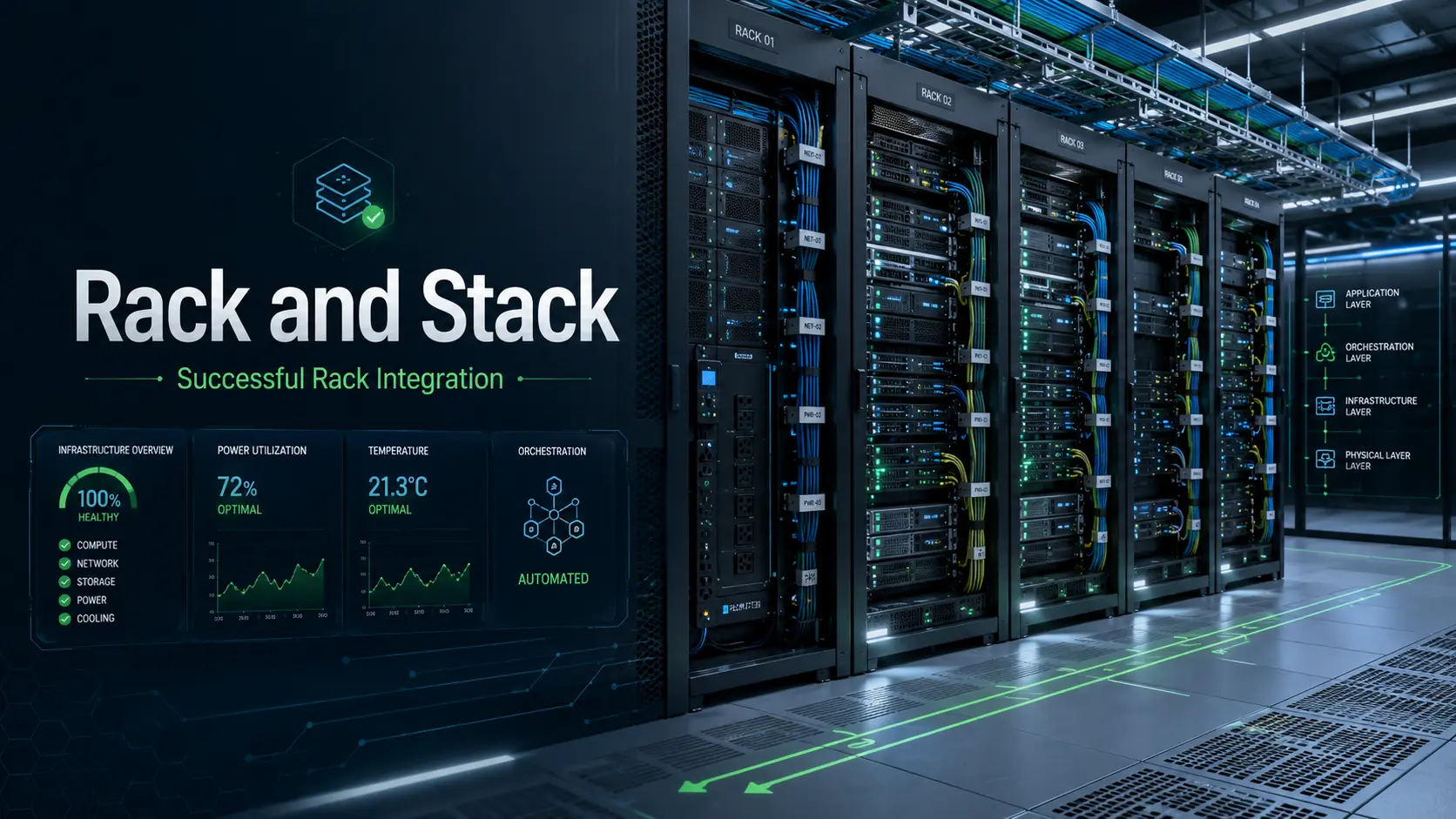
Rack and Stack: Successful Rack Integration
PublishedDeploying new enterprise IT infrastructure is always a milestone for a growing business. Unboxing state-of-the-art servers, high-speed network switches, and advanced storage arrays represents a massive leap forward in computing power. However, simply owning top-tier hardware is only half the battle. The true success of your investment relies entirely on how that hardware is physically deployed, organized, and connected.
It might sound like a straightforward task of mounting metal boxes into a standard 19-inch steel enclosure. In reality, precision rack integration is an art form. It requires meticulous spatial planning, strategic weight distribution, precise thermal management, and highly structured cable routing. When done correctly, successful rack integration transforms a chaotic cluster of complex machinery into a clean, highly efficient, and reliable engine room. When rushed or mismanaged, even the most expensive hardware can become an inefficient, overheating liability which we can easily overcome with Exeton.
Why Proper Rack Integration Matters
In high-density computing environments, treating rack integration as an afterthought is a recipe for operational disaster. Proper integration is about far more than just neat aesthetics, it directly impacts hardware lifespan, system efficiency, and workplace safety.
1. Thermal Optimization & Airflow Control
Enterprise hardware is engineered for strict front-to-back or side-to-side airflow dynamics. When racks are crowded haphazardly or choked with unmanaged cabling, exhaust vents get blocked and trap hot air. This creates stagnant heat pockets, forcing internal fans to spin at maximum RPMs wasting power and accelerating mechanical failure. More critically, high ambient temperatures trigger thermal throttling, forcing expensive CPUs and GPUs to drop performance to prevent burnout. Proper integration uses strategic equipment spacing and blanking panels to cleanly isolate hot and cold aisles.
2. Reducing MTTR and Protecting Uptime
A chaotic rack dramatically spikes your Mean Time to Repair (MTTR). When a critical switch or power supply fails, technicians shouldn't have to waste hours tracing wires through an unlabelled, tangled web of cables. Furthermore, loose cables hanging under tension put physical strain on equipment ports. It is incredibly easy for a technician sliding a server out on its rails to accidentally snag and unplug an adjacent live wire. Meticulous integration using structured managers, color-coding, and dual-ended labeling turns frantic troubleshooting into fast, risk-free hot-swapping.
3. Structural Stability & Physical Safety
The sheer physical weight of a fully loaded 42U or 48U rack can easily exceed 900 kg (2,000 lbs). Installing heavy equipment like dense storage arrays (SANs) or massive UPS batteries near the top creates a severe safety hazard. Top-heavy racks compromise structural stability; when a heavy server is extended on its sliding rails for maintenance, the center of gravity shifts forward, creating a critical tip-over risk. Professional integration means building from the ground up placing the heaviest units at the base to keep the setup perfectly grounded and safe.
Who Can Mainly Benefit?
Enterprise IT Teams: Companies upgrading their office servers, moving hardware, or setting up hybrid networks.
Growing Data Centers: Facilities expanding their floor space that need standardized, neat, and repeatable setups.
High-Performance Labs: Teams running heavy AI processing, or complex rendering that push power and cooling to the absolute limit.
Cloud & Telecom Providers: Network operators who require maximum uptime and cannot afford a single loose cable causing a service outage.
How Exeton Transforms Your Infrastructure: Our Integration Workflow
Exeton doesn't just deliver advanced hardware; we provide completely optimized, deployment-ready infrastructure. Our specialized engineering teams take the complexity out of data center setups by executing a rigorous, end-to-end integration workflow:
Complete Hardware Assembly: Precise mounting of servers, switches, storage arrays, PDUs, patch panels, rails, blanking panels, and cable trays into the rack.
Precision Cable Management: Meticulous routing and bundling of both power and network cables to eliminate clutter.
Device & Cable Labeling: Full labeling of all cables and physical devices on both ends to make ongoing maintenance effortless.
Power & Airflow Optimization: Strategic power distribution setup combined with strict weight balancing (heavy at the bottom) and optimized airflow alignment.
Rigorous Testing & Validation: Full basic configuration, system testing, Burn-in testing, and FAT (Factory Acceptance Testing) to ensure complete hardware stability before deployment.
Granular Documentation: Delivering complete maps of port assignments, exact Rack Unit (RU) positions, and all terminal connections for your engineering teams.
Take a look at this table below for better understanding
Feature | Integrated Rack | Non-Integrated Rack |
|---|---|---|
Hardware Lifespan | Extended Lifespan: Hardware runs cool, maximizing its total operational shelf life. | Reduced Shelf Life: Constant high heat degrades internal components, killing expensive hardware years too early. |
System Risks | Safe & Stable: Low risk of errors, outages, or sudden component meltdowns. | Serious Failures: High risk of sudden system crashes, permanent hardware failure, or data loss. |
Cooling | Keeps hardware cool and prevents system slowdowns. | Traps heat, creating dangerous hot zones inside the rack. |
Cabling | Labeled and neat; incredibly easy to trace wires. | Messy "spaghetti" wires that are a nightmare to navigate. |
Maintenance | Repairs take minutes with zero accidental unplugs. | Troubleshooting takes hours; high risk of pulling loose live wires by mistake. |
Safety | Perfectly balanced and safe from tipping over. | Top-heavy and dangerous for technicians to work around. |
The Bottom Line on High-Density Deployments
Ultimately, a server rack shouldn't look like a chaotic web of wires especially when hosting high-performance AI hardware. As we have covered, proper "Rack and Stack" integration is a direct investment in your hardware's lifespan, thermal stability, and operational safety.
Skipping proper setup leads to reduced shelf life, dangerous hot pockets, and catastrophic system failures. On the other hand, a professional build ensures your infrastructure is fully tested, perfectly balanced, and engineered for maximum uptime right out of the gate. For IT specialists pushing the limits of modern computing, meticulous rack integration isn't an afterthought it is the baseline for reliable, long-term performance.